Mark 16:9-10 (Matins)
1 Timothy 2:1-7
Luke 4:16-22
Acceptable
So He came to Nazareth, where He had been brought up.
(Lu 4:16)
In the Name of the Father and of the Son and of the Holy Ghost. Amen.
We gather at least once a week to reflect on our journey to the Kingdom of Heaven.
This journey is all-encompassing.
We turn away from our former, worldly lives, body and soul (Lu 18:22).
We say that here we have no abiding home (Heb 13:14).
We are strangers in a strange land (Exod 2:22).
We follow our King Who had nowhere to lay His Head (Mt 8:20).
(And as I look around this room,
I see that we still have no unpacked from Haiti.)
Our only stable identity is the model for all human life:
the God-man, Jesus of Nazareth.
If someone were to ask us,
"Who are you?
And what are you doing?"
we simple follow St. Peter's advice
given in his First Epistle.
We are simply ready
to give a report
concerning the hope that is within us."
That is all.
That is we are:
the ones who hope.
By His command, we are pilgrims and helpmates to one another.
We encourage each other on the journey.
We help each other through life's struggles and meet each other's material needs
(Mt 25:31-46, Lu 10:25-38).
We love one another.
And by this we are known as His disciples (Jn 13:35).
The world sees the outward, material aspects of our lives .....
and many times scratch their heads.
They are apt to say,
"These large buildings?
This farm which has been established over the last ten years?
A thousand feet of water lines buried three feet in the earth?
All the roads that we established?
A fence surrounding eight acres?
This was done by two nuns?"
And I reply,
"Two elderly nuns and their hapless chaplain.
Yes, that is true.
For God chooses the weak, the foolish, and the lowly,
that His Presence be known on earth" (1Cor 1:27),
that in all things God may be glorified through Jesus Christ, to whom belong the glory and the dominion forever and ever"
(1Peter 4:11).
"And you receive no pay?
"That is true.
We are children of the Most High.
Does a worker extort his mother or father?"
"And the Church gives you no support?"
"That is true.
The Church does not give to monasteries and parishes;
we give to the Church" (Heb 7:8).
"The farm has run in the red for ten years?"
"That is true,
by the grace of God, for 'in Him we live and move and have our being' (Acts 17:28)."
"I just don't understand it," they say and walk away.
You see,
mostly, the journey is not about established a farm
or
building buildings
or
laying up treasure.
The journey is mostly an inward one.
We realize that
the Kingdom is an interior reality
constantly coming about
so long as we continue to follow.
This is important:
the Kingdom is
constantly coming about
so long as we continue to follow Him.
So we reflect together upon all this.
This is our journey.
Now, should this deeply mindful life
and
faithfulness stop,
then
the Kingdom no longer comes ..... at least, not into the world
here at the Hermitage.
This realization is a mark of our spiritual maturation.
After all most of the Western and Eastern parishes of the
world go forward
by saying the words
and
turning the pages,
but very few lives are transformed.
This so-called spiritual life
is about
checking the list,
doing your duty,
and
refraining from certain things.
Such a life inevitably
becomes focused on "What is the least I can do and still 'go to Heaven.'"
Then,
the realization comes:
spiritual life in not about "all that" .....
well,
let us say, "all that, but experienced in its fullness through mindfulness."
Spiritual life is about ..... this, about our hearts,
that is, the state of our souls.
This is spiritual maturation.
Yes,
surely we are dependent upon Him.
Without Him we can do nothing (Jn 15:5).
And who has not felt God's grace flowing through us,
giving us power.
Yet,
in the realm of human affairs,
ironiclally,
He can do nothing without us.
Returning to the allegory of the vineyard from last week,
we are not merely passive soil.
We must be diligently cultivated.
We must become
rich in spiritual nutrients.
And who is left to do this work but ourselves?
On reflection,
He has appointed us.
We have no doubt about that.
You see,
we came from a distant island.
We had no home.
Then all this happened.
Our journey is a moment-by-moment thing.
Our reflections cannot but be "snapshots of the spiritual life."
But as the road rises to a hilltop,
we are able to see a broader and longer expanse.
We see where we have been.
We look ahead to where we are going.
We ask questions.
Where are we on our journey?
What does the road ahead look like?
And most important,
are we following God's will for our lives?
This hilltop has a name:
the Church New Year.
By the way,
"Happy New Year"
on this New Year's Day.
We mark the Church New Year today
for this year the First of September falls on a Sunday.
The Western Church,
and consequently the secular West,
observe the New Year on January 1
after the edict of the Second King of Rome (Numa Pompilius) in 713 BC.
He called the first month Ianuarius (Januarius)
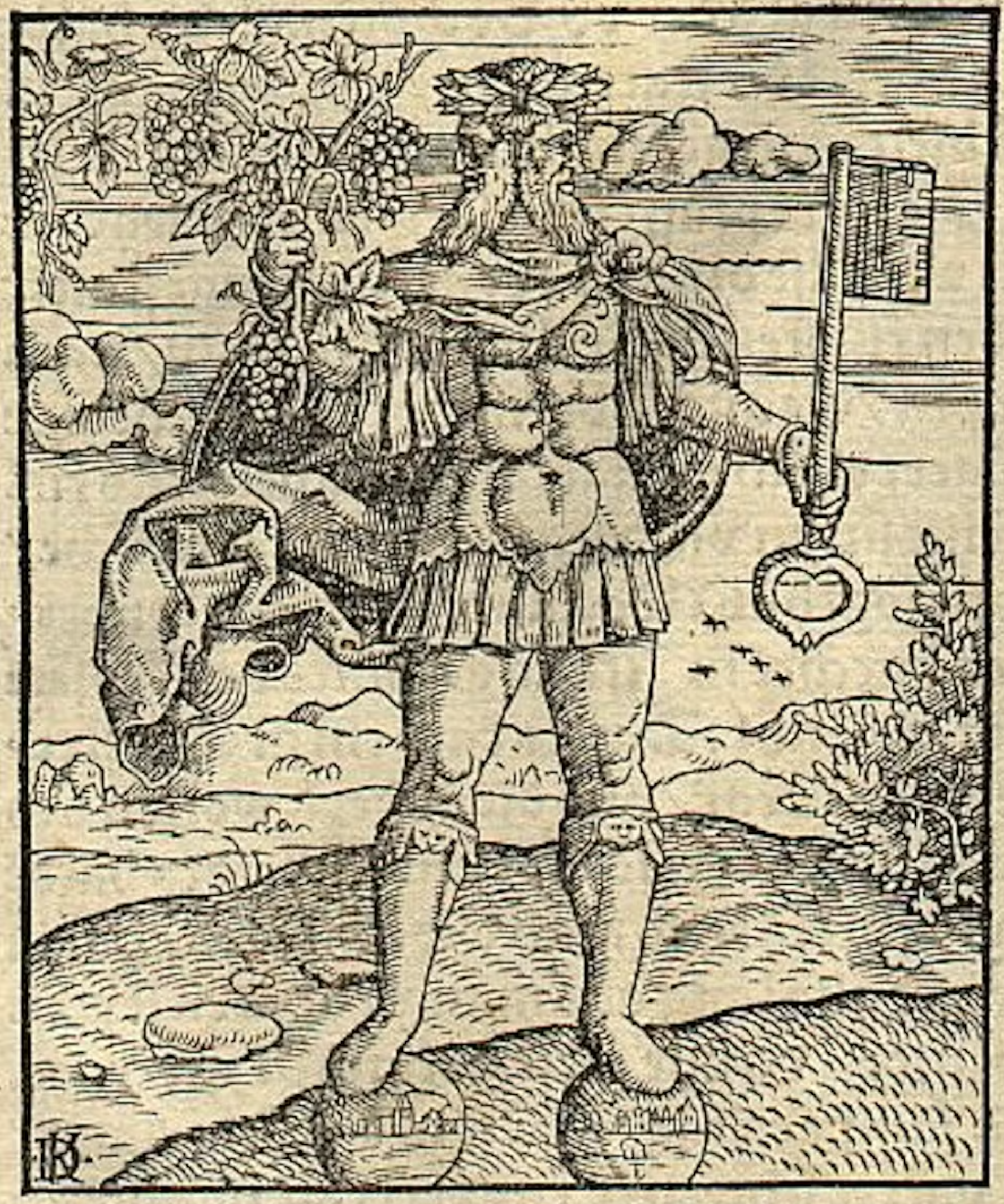
derived from the pagan divinity Ianus (Janus)
—
the god of doors, gateways, and passages.
The two-faced Janus looks both ways
surveying the path directly behind
and
the way directly ahead.
His fixed eyes are purposeful,
therefore,
not straying to
the side
nor
looking at the by-ways or other distractions
(unlike Cerberus, the multi-headed hound of Hell
who restlessly looks in all directions).
Janus bears the walking staff of the pilgrim.
He also holds
the key that unlocks the gate,
which is the seeker's goal.
A medieval development in the iconography
depicts Janus holding grapes from the vine,
which casts the Christian light of eschatology on this figure.
Here at the threshold,
the question is obvious.
In the Last Judgment,
God will hold these grapes up and decide
whether they are
acceptable
fruits.
Or are they wild grapes overseen by wicked tenants?
.... who we are if the grapes do not have a holy savor.
That is,
the new year is the time
to see where you have been,
and
to contemplate where you are going,
to take stock.
Now, taking stock goes to the very heart of being Christian.
St. Anthony the Great (b. circa 251),
the "Father of All Monks,"
was said to have "taken stock"
every night
in a regular examination of conscience.
The many men who were drawn to him emulated this nightly ritual.
St. Basil the Great, called the "Father of Monastic Communities,"
required nightly examination of conscience of all his monks.
As we open our Gospel lesson for the Church New Year,
we see that our Lord and God
Jesus Christ
exhorts us to take stock:
to take stock in who we are,
in what we are doing,
and
in where we are headed:
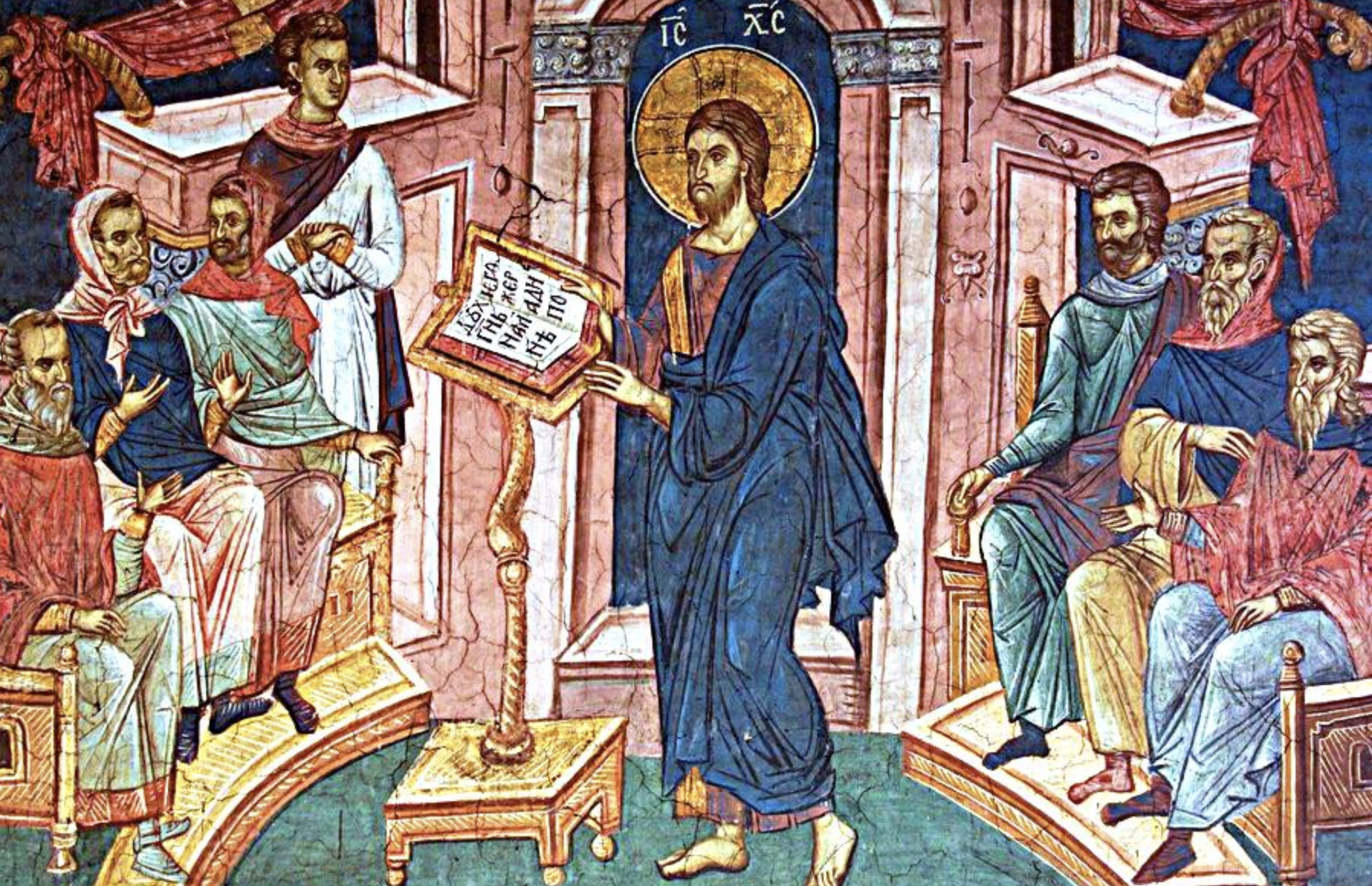
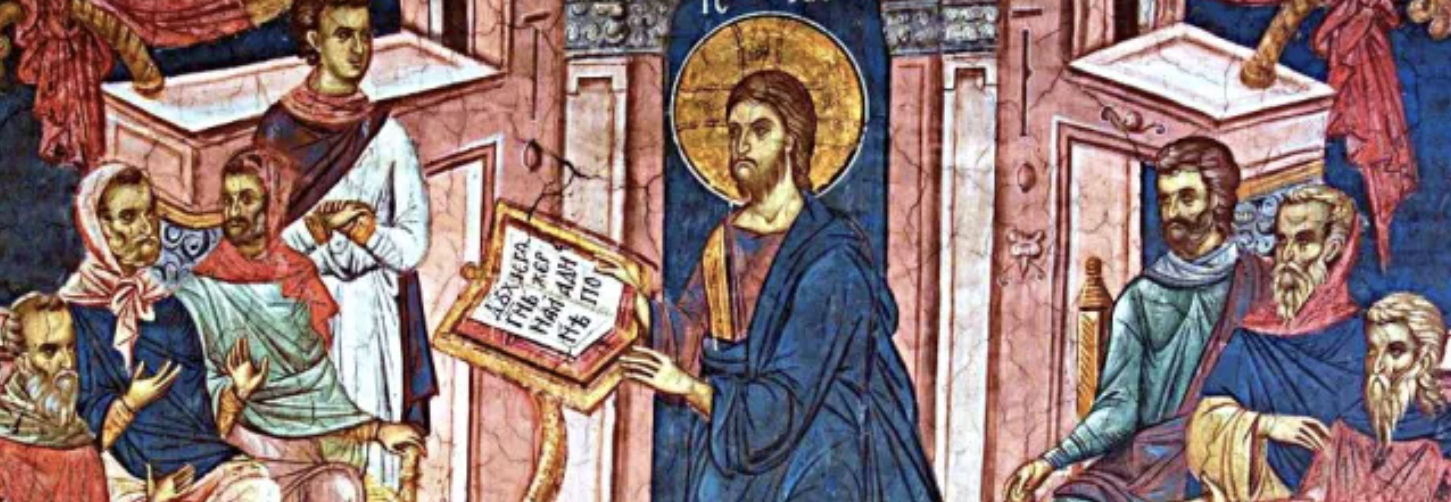
So He came to Nazareth, where He had been brought up.
And as His custom was, He went into the synagogue on
the Sabbath day, and stood up to read. And He was handed
the book of the prophet Isaiah. And when He had opened
the book, He found the place where it was written:
"The Spirit of the LORD is upon Me,
Because He has anointed Me
To preach the gospel to the poor;
He has sent Me to heal the brokenhearted,
To proclaim liberty to the captives
And recovery of sight to the blind,
To set at liberty those who are oppressed;
To proclaim the acceptable year of the LORD."
(Lu 4:16-19)
|
The return of the youth to his homeland is a literary trope.
In fact, with the advent of the novel in the eighteenth century,
this trope would develop into a literary genre called
the
bildungsroman
(the story about spiritual development),
where the return to one's beginnings
is depicted for the purposes of measuring the protagonist's moral or spiritual development.
Is this not inevitably the case when we return to our hometown after many years?
The difference in us i seen.
We hope it is a positive difference
and
not a negative one
(so often a negative one).
Charles Dickens'
David Copperfield,
James Joyce's
The Portrait of the Artist as a Young Man,
and
J. D. Salinger's
Catcher in the Rye
are examples.
German scholars of the nineteenth century noticed that both the
Iliad
and
the
Odyssey
are examples of the
bildungsroman.
And, of course,
Jesus of Nazareth's "Parable of the Prodigal Son" fits the genre classically.
But these examples are from literature.
What can it mean for God to be held to account and measured for spiritual growth?
Even to draw near to such a premise
must needs be dangerous.
For it cannot possibly be God Who is under examination
in such an absurd scenario.
If such a conversation were to begin, it must certainly turn back upon ourselves,
the ones who have asked such an impertinent question.
And such a turn-about we see in our New Year Gospel lesson.
And in turn Jesus opens the book to His most sacred text,
the Book of the Prophet Isaiah,
asking what our lives are about,
our purpose in the journey to God,
or
as Isaiah
frames it:
"the acceptable year."
The underlying Greek text is
ενιαυτον Κυριου δεκτον
/
eniautòn kuríou dektón.
The multitude respond with insolence:
"Is this not the Joseph-the-carpenter's son?!
meaning,
"Who is this that presumes to wear the mantle of the prophet?"
The key word is
δεκτος
/
acceptable.
What will God accept?
Whom will God accept?
And He turns the question out to them.
For their part in God's cosmic drama
is to accept and honor His Son.
As we know,
this is what Father God has set out to be the minimum acceptable behavior:
For God so loved the world, that He gave his Only Begotten Son, that
whosoever believeth in Him should not perish, but have everlasting life.
(Jn 3:16)
|
You see this word believeth
means that we instantly fall to our knees.
This is the Son of God!
This is the Anointed One!
And we cry out,
"Have mercy on us, Son of David!"
And Jesus responds to their insolence by reprising
this word
δεκτος
/
acceptable:
He said to them, "You will surely say this proverb to Me, 'Physician, heal yourself!
Whatever we have heard done in Capernaum, do also here in Your country.'" Then He said,
"Assuredly, I say to you, no prophet is accepted in his own country. But I tell you truly,
many widows were in Israel in the days of Elijah .... but to none of them was Elijah sent
except to Zarephath, in the region of Sidon, to a woman who was a widow. And many lepers
were in Israel in the time of Elisha the prophet, and none of them was cleansed except Naaman
the Syrian."
(Lu 4:23-27)
|
The people respond with full-blown rebellion,
rebellion against God:
So all those in the synagogue, when they heard these things, were filled with wrath, and
rose up and thrust Him out of the city; and they led Him to the brow of the hill on which
their city was built, that they might throw Him down over the cliff. Then passing through
the midst of them, He went His way.
(Lu 4:28-30)
|
He has returned to the village where He had been brought up.
The King has returned.
And He is called to account by the villagers
and
condemned to death.
Yet none is able to set a hand upon Him, Who is the Son of God.
On this day in Nazareth
a great judgment has occurred.
For those present it has been a Last Judgment.
Their King has been condemned to death,
but His judge and jury turn out to be the condemned.
And it has all turned on a pun:
acceptable.
The three Patristic
levels of Scripture are alive here.
Jesus' visit to His village is a historical fact
as
is the judgment He has pronounced.
It is also set out as an allegory for all humankind.
Indeed,
this same scene will be reprised in Jerusalem
on the eve of His Crucifixion,
which is the burning point of all history.
You see,
it plays out over and over again,
like an archetype,
like the greatest fact of the human story.
The great judge asks His question to everyone born into the world:
"Who do you say that I AM."
And this intersection of man and God
faultlessly points to the Last Four Things.
Oh, my goodness!
Let us therefore make haste
and
go back to His original text,
for surely we will
learn there what is acceptable to God.
Have we been acceptable?!
•
Have we brought good news to poor?
•
Have we healed the brokenhearted?
•
Have we worked to free those have been unjustly imprisoned?
•
Have we done our part to heal the blind (and the spiritually blind)?
•
Have we consoled the oppressed?
That is to say,
have we sat on ground next to them,
looked into their eyes,
and said
"I am here with you."
These are questions that the Lord Jesus puts to us.
Have we labored to bring about,
in own worlds,
what is
acceptable
in God's sight?
That is,
are we
acceptable?
As Christians we do not pop corks of champagne
on New Year's Eve.
We do not put on revels till dawn
pausing at midnight to pour another round.
No.
We return to our beginning.
We have reached the end,
as we return to our beginning.
We reflect on where we have been.
We examine ourselves to gauge our moral growth.
And,
if we havve disappointed God,
we stand up
and
dust ourselves off
and
begin again.
For everything hinges upon this .....
in our own individual lives
and
in the always becoming
(we pray)
of the Kingdom of God.
It all depends upon our mindfulness
and
upon
our faithfulness.
In the Name of the Father and of the Son and of the Holy Ghost.