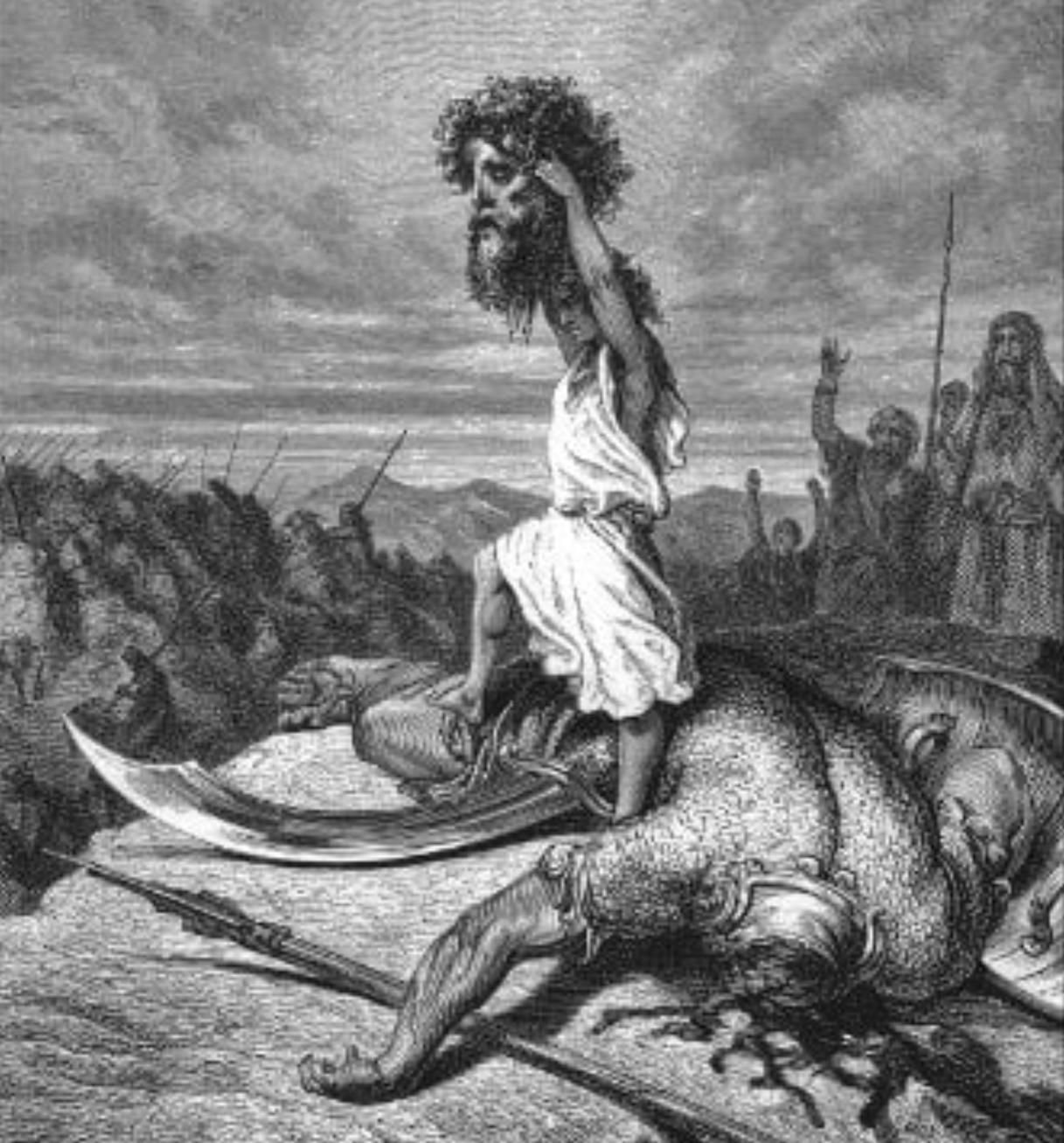
The Greeks, following Aristotle, believed that man's upright posture revealed his essential divinity. The head is the highest, most noble part. The eyes are the windows to the soul, a premise obviously attested in Jesus' teaching,
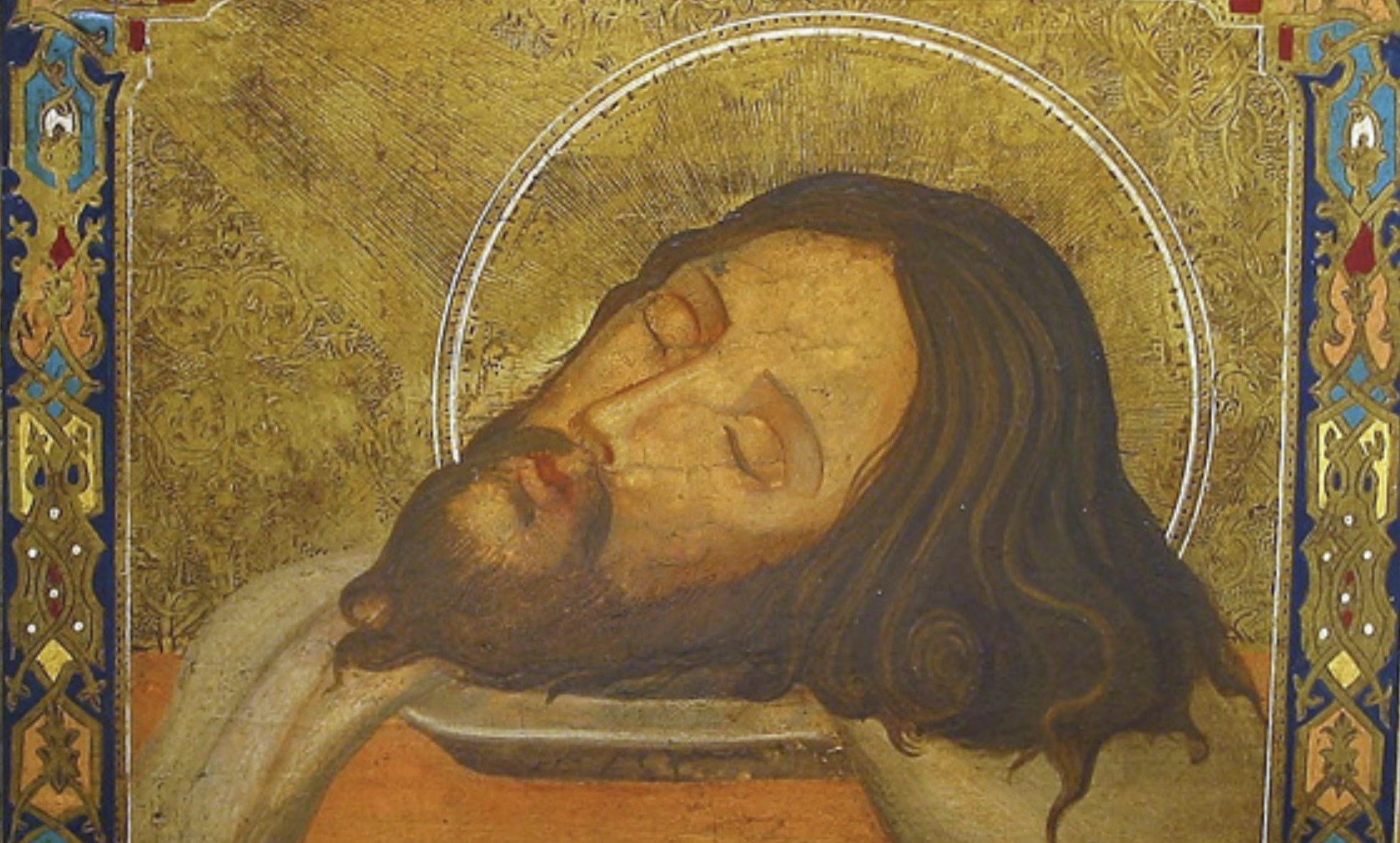
The phrase capital punishment falls on our ears as a harsh sound. It literally means "removal of the head." For the words capital and decapitation share the same root: from the Greek κεπηαλή / kephalé through the Latin caput. The phrase tries to convey the most humane way to take a human life. In Medieval and Renaissance England, beheading was reserved for the aristocracy and nobility — the Queens of Henry VIII; the paramour of Elizabeth I, the 2nd Earl of Essex; Sir Thomas More, Cardinal John Fisher. Sir Walter Raleigh tipped his executioner to ensure that the blade be razor-sharp. Centuries later in France, the advent of the guillotine extended this swift, uncomplicated, and painless death to all social classes.
Why then should this graphic act so profoundly disturb us? Far from being comforted, we are traumatized at the thought of decapitation. And this is right. For in which other form of execution do we see our Heavenly part separated from our animal bodies?
The Greeks, following Aristotle, believed
that man's upright posture
revealed his essential divinity.
The head is the highest, most noble part.
The eyes are the windows to the soul,
a premise
obviously attested in Jesus' teaching,
|
"The lamp of the body is the eye. If therefore your eye is good,
your whole body will be full of light." (Mt 6:22) |
When we think of ourselves as bearing the image of God, do we think of our feet or our legs or our arms or our hands? No, of course not. We instantly surmise that the head possesses this noble, even Divine, bearing. As the Scriptures record (Exod 34:35) and experience teaches, it is the radiant face which evinces the indwelling of God.
Beheading, therefore, signifies a complete domination of the victim. A faint echo of this is heard in our phrase losing face meaning complete humiliation. When David removes the head of Goliath and holds it aloft, the effect is electric: a mere boy, of modest stature, has completely dominated the fearsome giant .... indeed has dominated the whole nation of the Philistines:
|
And when the Philistines saw that their champion was dead, they fled.
Now the men of Israel and Judah arose and shouted, and pursued the Philistines as far as the entrance of the valley and to the gates of Ekron, And the wounded of the Philistines fell along the road to Shaaraim, even as far as Gath and Ekron. Then the children of Israel returned from chasing the Philistines, and they plundered their tents. And David took the head of the Philistine and brought it to Jerusalem, but he put his armor in his tent. (1 Sam 17:51-54) |
Once the head, or headship, is taken quickly the body devolves into the chaotic and weak animal it is. Which other amputation is fatal or yields the same effect of grotesquery?
Ironically, purely material explanations emphasize the humaneness of decapitation. Other methods in the ancient world — being broken on a wheel, being drawn and quartered, being burned at the stake — were protracted and unbearably painful. Ironic, I say, for no other form of execution de-humanizes more than decapitation removing the stamp of God set upon the human creature. There is an important scientific point to be made, though. Other methods of execution (tortures really) were intended to extract words, to make people talk. Beheading silences them. Today, we celebrate the vain attempt to silence the voice of God spoken by His most holy human voice and prophet.
St. John the Baptist was the man come from Eden, whose fragrant purity was redolent of the morning of the earth, who was dressed only in natural attire, who fed on manna, who had nothing of the city about him. Surely, this was the one who might lead us back to original purity.
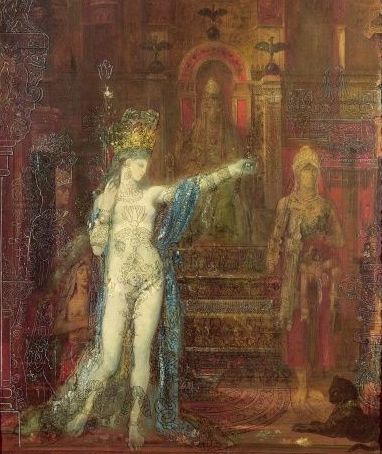
Here is
a study in opposites:
the man fragrant of Paradise set against the stench of a drunken orgy;
the man of gracious words set against reckless living and rash oaths;
the man of purity set against filthy desire;
the peerless friend of God set against the murderers of God's Son.
And we watch these oppositions set into motion
through beguiling music,
through a stupefying flood of wine,
in a room hazy with incense,
and
displayed before all,
the sinuous body of a girl swirling in this trance of polluted desire.
Here is a rich tableau depicting
the ancient war between body and soul,
between the body's brutish inclination and the head which aspires to Heaven.
All is laid bare in a strange ritual of writhing carnality,
which attempts to exalt the sensual body in a rebellion against the
the seat of reason and conscience.
John the Baptist is to be silenced. But God cannot be silenced. No. Indeed, in this attempt, God speaks with greater force still, revealing a sovereignty which cannot be resisted, much less silenced. Initially, John had condemned Herod Antipas for marrying his living brother's wife who was also his niece. But now the crime is redoubled as Herod lusts for his niece's daughter who is also the granddaughter of his brother and now his own stepdaughter. The more we seek to elude God, the more we find ourselves trapped in a web of myriad affronts against Heaven, one shading into a another. "God help the man so lost in error's endless train," wrote Edmund Spenser.
Indeed, At Herod's revels the principal offenses against Heaven are compact into one evening's entertainment: rebellion in Paradise (Gen 3) as the man of Eden is overthrown; "the intent of the thoughts of man was only evil continually" (Gen 6:5) as a general lasciviousness descends; father-drunkenness and mother-incest in Noah's family (Gen 9:21-25) as Herod grasps at union with his niece and sister-in-law; father-drunkenness and daughter-incest of Lot's family (Gen 19:32-34) as Herod lusts for his step-daughter; and the disfigurement and murder of the greatest prophet born of man and woman, which we observe today. The culmination of all at a single banquet reaches down into man's darkest imaginings and enshrines them in one tableau.
Meantime, intoxicating himself with the same depraved sensuality that had tainted God's Second Creation, Herod would silence the faithful one, the one who announced God's Final Creation by way of the Incarnation, the one one whom he will silenced. Still, the Forerunner is heard never more clearly than against this grotesque backdrop.
By the grace of God, Herod has been brought to a crossroads. He has sent an incomparably holy and eloquent prophet to bring the Tetrarch to his senses. Herod rightly discerns John's Divine pedigree. He brought John before him. He listened to John carefully. He revered John. He stands at a crossroads. On one side lies fatal compulsion and fantasy and carnal desire. On the other, an emissary of God bringing him to a Divine appointment. The godly way has been opened. Nothing stands in his way. In the presence of highly honored guests, he might make the salutary and commendable choice: to throw off the filthy bondage of adultery, incest, and forbidden fantasies. But he does not. In one despicable act, in a fever of drunkenness, ego, and perversion, he leaps into the pit of Hell.
Meanwhile,, having so much free time, impaired reason combined with amplified sensuality sit for hours entranced before Salome's dance in the form of pornography and its follow-on: hook-up culture. And the mocking dismissal of God and His messengers has become the national temperament.
Whoever surrenders himself to sensual life will rapidly succeed in silencing the Heavenly part. Success will be swift carried along on a powerful current of demonic energy. Soon he will lose control as he is transformed into what we call an addict (possession would be more accurate). The symptoms are seen everywhere: the radiance that once shone from the face is quenched; the lamp of our eyes is dimmed unto deadness; the sensual body burns itself out now riddled with diseases. For this is the promise of Hell: "Abandon hope all ye who enter here" (Dante, Inferno).
Who would date debate fantasy and carnal desire now dominate our culture? And if you think that godly life and pornography are compatible, if you believe that God has granted you a special dispensation, then these are still further proofs that you are possessed. For God will not dwell in a polluted vessel, much less a vessel made in His Image which now mocks Him. Such irrational counsels do not proceed from Heaven but rather from the demon-mind which is insinuated itself into you. Yes, nothing can separate us from God's love. He is always present. But we can abandon Holy Love as surely as we abandon spouse and children and family.
Today, we observe the solemnity of "The Beheading of the Glorious Prophet, Forerunner, and Baptist John." Surely, it is a feast celebrating our God Who cannot be silenced, much less dismissed. But today's solemnity is celebrated as a fast (one of the few Sunday's of the year observed in sack cloth and ashes). For today, we "sit upon the ground. And tell sad stories of the death of kings" (Richard II, III.2) For the head is our royal part, the luminous dome of the Holy Spirit's temple, which is the body (1 Cor 6:19). Its overthrow is a sad, sad tale and the story of our times.
Yes, God has prepared a place for those who love Him. And we give thanks for that. But today, let us grieve the plight of those who will not see this place, who are utterly lost, and who show few signs of life. Of those who seek treatment and carry through with it, 85% will return to their drug habit in one year. Ultimately, only seven percent will ever return to healthy life. Among pornography addicts, only 1 in 100,000 will experience a spontaneous remission. And only 5% of those who enter therapy will be cured. It is unpleasant to contemplate, but these are our nieces and grandnieces, our children and grandchildren, and and countless mothers and fathers whose lives have effectively ended.
On this day of fasting, let us open our eyes and hearts to the degradation all around us. As we are able, we must reach out to these young people. We must provide a wholesome example of life. We must show them the gentle character of pure love that is free from lust. They will remember. They will recognize sanctified life when they see it, which is the world of their magical childhood.
We must place our hope in our good desires. St. Paisios wrote,
| Desire and effort must come from you. God will provide the power and the result. |
Today, the prophet of whom none was greater speaks. Still he speaks. He speaks powerfully into our time and place. And we must listen. For in spiritual things — our scientific advances and dazzling technologies notwithstanding — we have advanced not at all. Indeed, we have fallen behind the first century A.D. For a general awareness of God and knowledge of God's way have been mostly become lost to us.
On this fast day, let us mourn. Let us remember our Heavenly part. Let us recall St. John the Baptist's cry in the wilderness summoning us to original purity. For he boldly advances against the enemies of God declaring truths which no one can silence. He speaks to us now: Shake off your carnal trance! Be washed clean! Lift up your eyes! You bear upon you the Holy Image of God!
In the Name of the Father and of the Son and of the Holy Ghost. Amen.