Luke 24:1-12 (Matins)
2 Timothy 3:10-15
Luke 18:10-14
"Who Then Can Be Saved?"
"Who then can be saved?"
(Lu 18:11,13)
In the Name of the Father and of the Son and of the Holy Ghost. Amen.
|
Our lesson this morning contemplates the rich.
Now, I must confess:
we know many rich people.
In fact,
by the world's standards,
they are extremely rich people.
And we spend more than a little time worrying about them,
our family,
our friends
and
acquaintances we love,
for
how can their lives square with Jesus' plain and (quite) direct teachings?
The Gospels present us with many rich men.
This morning I would like to reflect on
a man who presents himself as one who is rich,
yet is not.
The irony is, he is a man of God.
Now, why in the world would a man of God wish to make pretenses of great wealth?
He is matched in a parable to another man who, in fact, is rich
but deeply regrets his life and his riches.
I am thinking, of course, of the proud Pharisee and the penitent Publican.
Now, here is a reversal of expectations:
a poor-man-who-is-proud
and
a rich-man-who-is-humble!
Perhaps, over the centuries, we lose sight of this glaring fact about
the Parable of the Publican and the Proud Pharisee.
For example,
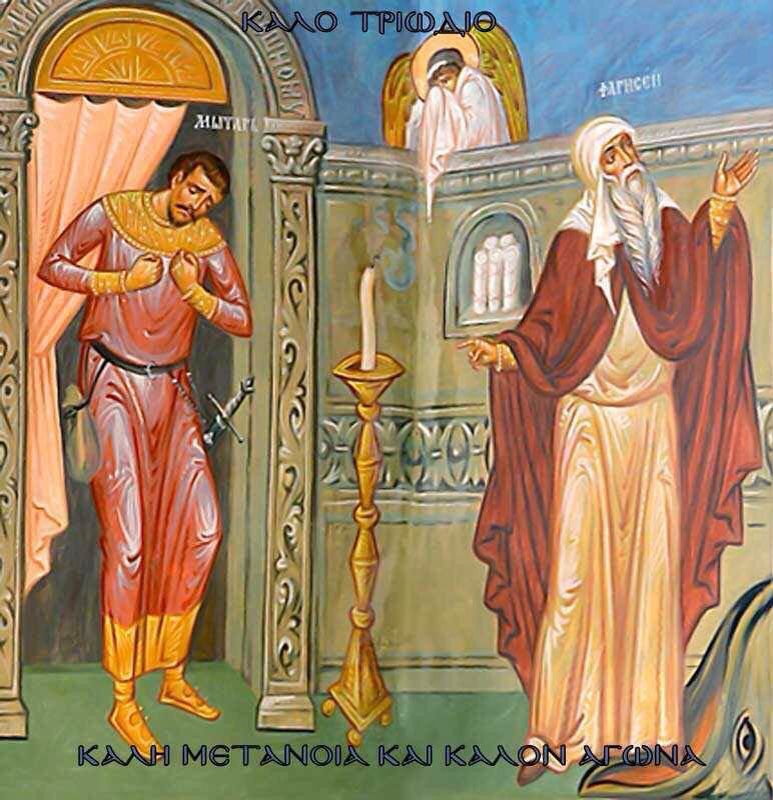
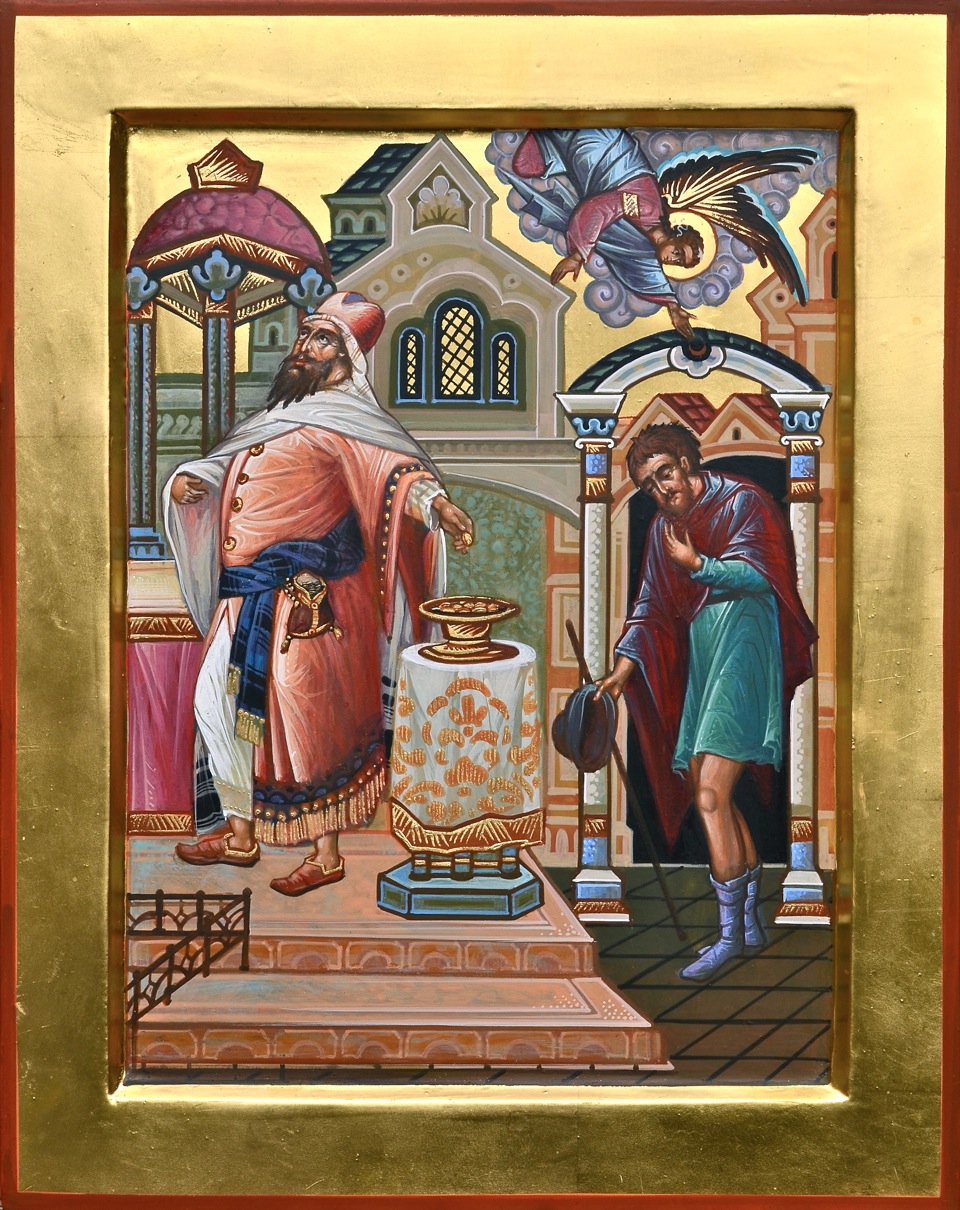
I have seen icons from previous centuries depicting the Pharisee
turned out in costly silks edged in
royal purple (that most expensive of dyes)
cutting a portly figure
befitting one who feasts sumptuously every day.
He wishes to be seen making ostentatious gifts to the Temple.
"I give tithes!" he exclaims.
Riches are a primary focus of such icons
featuring
a plate full of gold coins in the foreground.
Meantime, the Publican is represented off to one side,
perhaps standing behind a pillar,
in the shadows so to speak.
He is dressed in simple garb, undernourished, and bearing
the itinerant's walking staff
all suggesting that he is little more than a beggar ....
as I say,
the beggar who not a beggar
and
the rich man who is not rich.
No doubt,
there is a spiritual logic here.
For pridefulness implies exaltation of the self and a wardrobe to match
while
humility always points to sack cloth.
In any case,
what you would have seen in
the streets of first-century Jerusalem
would have been quite the opposite.
We call tax collectors Publicans because they were
members of the Societas Publicanorum
of the Equestrian class, just below the Senatorial class.
These were men of high standing in Roman society,
managing public works projects,
supplying Roman Legions in the field with materiel,
ensuring that the regular census was taken,
and
(of course)
collecting taxes.
We should add that following
Augustus Caesar's tax reforms,
more than generation before Jesus' time,
taxes were collected under strict regulation.
In particular, "tax farming"
had been abolished
reining in
tax collectors
who imposed whatever monies they could manage to extort from the people.
Publicans were more likely to have dined with Sadducees
(i.e., Jewish aristocrats)
than would have Pharisees or the ascetic Essenes.
That is,
the Temple rulers
—
who rejected the immortality of the soul,
resurrection,
or
the existence of angels
as fairy tales
—
would have had more in common with Roman Publicans, Tribunes, and Senators
than with lower-class Pharisees,
whom they would have deemed religious fanatics.
In fact,
the Levant had been an international zone for centuries
before the Christian era.
It was not a dusty backwater,
as Hollywood movies imply,
but a great cosmopolitan center.
Thanks to Alexander the Great,
the world spoke Greek
even in Rome (where public monuments of the first century have been discovered
bearing Greek inscriptions).
First-century Judea was Graeco-Roman culture
with its classical, white temples, its colonnades, and colosseums.
Perhaps Sr. Mary Anne has visited the Decapolis (the Ten Cities)
which looks like a Roman ruin.
Judean boys attended gymnasiums teaching Greek ideals called Paideia
and
participated in Graeco-Roman sports.
A young man aspiring to influence in Roman society
would not be held back on account of his Jewish parentage
with many boys seeking to reversing their circumcisions surgically
to remove any sign that they might be different.
We might ask, "What difference would it make so long as they kept their trousers on?"
But we could misunderstand this culture
where boys competed in sports in the nude.
Class and ethnic boundaries were fluid in the diverse Roman Empire.
Consider the case of
Yosef ben Matityahu,
a former rebel (in Rome's eyes)
and military commander during the Jewish Wars.
He became a slave to an influential Roman
who then facilitated his ascent into the upper echelons of society.
He adopted the name Titus Flavius Josephus
and
became a much-read historian debating with the leading lights among Roman writers.
His books advanced the idea that the Jews represented one of the great
civilizations of history
standing beside Egypt or Rome.
His writings still afford
valuable windows into first-century Judean culture.
Like the wealthy Publicans, Zacchaeus or Matthew-Levi,
he mixed with the "upper crust"
of Roman society in Jerusalem.
In fact, he would not have been very different from the Publican in Jesus' parable.
By contrast, the Pharisee of Jesus' story would have been poor as a church mouse.
He would have spent his days studying Torah by way of an unending rounds
of oral debates,
similar to the Socratic method
of posing questions
and
debating various answers.
We today might perceive the Pharisees' questions put to Jesus
as being impertinent.
But that is not the case.
Jesus is simply being invited into the debate.
The young ruler .....
and when we say ruler (archón
we probably mean the ruler of a synagogues
and
would have been a Sadducee.
The young ruler comes to Jesus and honors Him.
and
invites Him into theological debate:
"What is the greatest commandment?"
he says.
We are familiar with this custom having heard
other discussions:
"Is it lawful for a man to divorce his wife?"
"A woman had seven husbands who were brothers ....."
and so on.
But this was the mainstream method for instruction.
It was
fluid, spirited, and open-ended.
Needless to say,
none of these Pharisees, much less their students, would have received a stipend.
These were scholars living in penury.
We may read that their phylacteries were broad,
but we must pause here,
for today we do not really know what phylacteries were.
But whatever they were,
we may be sure they were affordable for the financially strapped Pharisee.
What Jesus places before us
is the very great question of the rich man and his salvation.
After all,
this has been a primary theme found throughout the Gospel of St. Luke.
The word rich occurs only six times in each of the Gospels of Mark and Matthew.
It occurs not
at all in the Gospel of John.
It is rare in the Pauline correspondence.
Yet, in St. Luke's Gospel, we encounter the word eighteen times.
We think of
the Parable of the Rich Fool (Chapter 12),
of the Rich Man and Lazarus (Chapter 16),
and
of the Prodigal Son,
which related the bequest of a large estate among two brothers (Chapter 15).
We hear the theme sounded
from the lips of the Most Holy Theotokos:
|
"He has filled the hungry with good things, And the rich He has sent away empty."
(Lu 1:53)
|
Jesus Himself pronounces it in the "Sermon on the Plain":
|
"But woe to you who are rich, ..."
(Lu 6:24)
|
St. Luke brings all to a
culmination in Chapter 18:
"How hard it is for those who have riches to enter the Kingdom of God!
For it is easier for a camel to go through the eye of a needle than
for a rich man to enter the Kingdom of God."
(Lu 18:24-25)
|
At this, Jesus' Disciples pose their own question to the Teacher:
|
When His disciples heard it, they were greatly astonished, saying, "Who then can be saved?"
(Lu 18:26)
|
Hearing the pronouncement about the camel and the needle's eyes,
is this not also our response:
"Who then can be saved?"
A lady in her seventies contacted me
—
I remember her as twelve-year-old
girl in elementary school
—
and asked me,
"Does God want to sell my expensive sports car?"
This is a question.
It is a
question that has echoed down through the ages.
Medieval aristocracy, gentry, and merchants were so filled with anxiety over this question
that Biblical commentators of their time
(aren't pastors always seeking to placate and reassure?)
I say their clergy invented a gate in the Jerusalem city wall
called "the Eye of the Needle."
They wrote that this gate was so narrow,
that a rich man could pass through it but only he if would lighten the load carried by his heavily laden camel.
The idea was that a rich man can enter Heaven ..... but let's not overdo the ostentation.
As I say,
an invention of the Middle Ages.
But this,
clearly,
is not the message conveyed in the Gospels.
Jesus told the rich young ruler
(recorded in all three synoptic Gospels)
"You still lack one thing. Sell all that you have and distribute to the poor,
and you will have treasure in Heaven; and come, follow Me."
(Lu 18:22)
|
If we were to choose one message heard from Jesus repeatedly
in the Gospels,
this would be it.
"Follow me."
And we know what this means:
"Burn down your whole world."
That is,
"Take up your cross"
.....
and fix our eyes entirely on this Beggar.
Are we any different than those anxious medieval merchants?
Jesus tells us that we must give away everything in order to follow Him,
but we cannot bear to hear it.
We moderns cannot bear to hear it.
It is in this same eighteenth chapter where we meet the Publican and Pharisee.
The Pharisee nominally has followed the religious life.
He has given up everything for this cause.
The problem is,
he wants everyone to know it.
And as he has stepped forward to claim his Heavenly crown,
Jesus poses the question (through His parable):
"What is Heaven? Is it a score card?
Is it a ledger comparing credits and debits?"
It all comes down to this:
whether you belong to the world
or
you belong to God.
Is it too much to say that this has been Jesus' constant
theme from the moment He opened His mouth to preach:
Metanoeite!
unto the day He went to the Cross,
a naked beggar?
Stripped of everything He had,
leaving no writings,
and
abandoned of all His followers
who might have carried on His legacy.
He is the most subtracted human being in history
as compared to the riches which were His.
We say
that we must love God with all or our mind and with all of our soul
and
with all of our heart,
as the young rulers poses
in our lesson this morning.
But if we should yearn for public recognition,
even honors and preferments from the Church,
we must admit that ours is not a heart fit for the Kingdom of Heaven (Lu 9:62)
as Jesus articulated nine chapters earlier in Luke's Gospel.
Beyond all dispute,
Jesus
has harsh words for Publicans.
For example,
if a man should refuse correction by the Church,
Jesus says,
"then let him be to you as a Gentile or a Publican" (Mt 18:17).
This pairing of the Gentile with the Publican
lays before us two worlds.
On one side,
we see
a world
of careerism
and
upward mobility.
On the other side are those who belong to God,
whose eyes and hearts long only for the Kingdom of Heaven.
They do not lay up riches for themselves.
Why should God's Son not turn a flinty countenance
to those who have spurned His Father?
They have been fed
with finest wheat,
sweet honey from the rock,
and
the best wine.
Why should Jesus not turn a forbidding countenance to these men and women of our own time?
He will turn the same face of flint toward the inhabitants of Chorazin and Bethsaida
crying "Woe to you"
(Lu 10:13).
Yet,
all of these many insults and injuries could be forgotten
if only the worldly would turn their hearts
and
face God in contrition.
This is the magic of Christianity.
We spend our lives doing things that do not honor God,
yet in the end we enter the Kingdom of Heaven.
Now, this really got under the skin of a friend of mine
at Bell Labs who was an Orthodox Jew.
We used to have lunch together,
and
he would always return to this subject:
"You people sleep with each other's wive.
You drink too much.
You live lives that dishonor God.
And
yet you claim to dwell with the Blessed One when it's all over.
At least that's what I hear:
you all 'go to heaven.'"
I said, "well, it's not as simple that.
We read in the play Hamlet
that King Claudius prays to Heaven.
But the words go up and fall back on his face.
They are not heard.
Do you think it is a simple thing to change?
Change
is famously the hardest thing in the world to do.
Yet, it is done.
And this is the irony set before us in our Gospel lesson.
☦
The disciples ask a question
we will spend the rest of our lives pondering:
"Who then can be saved?"
The implication is no one.
For everyone has too much of the world in them.
We hear the truth of this today.
I scarcely see the family I grew up with any more.
They are all gone.
But when I attend get-togethers among a wider circle of friends,
I see people pull up in their costly automobiles,
turned out in expensive clothing,
and
then hear of the three homes they possess,
and
I grieve.
The Sisters will tell you:
I think about it all the time.
But it is the sentence that follows this one
we spend the rest of our lives
replaying in our minds.
With high drama, Jesus declares:
But Jesus looked at them and said to them, "With men this is impossible,
but with God all things are possible."
(Mt 19:26)
|
We go back to this sentence again and again.
We cannot leave it ..... not where the salvation of our friends and family are concerned.
And
we ask,
"What exactly does He mean by the words?"
If we were but present, perhaps we would have asked,
"Master, could you go into this a little more deeply?"
Or perhaps these are the things unpacked
during the period we call "the academy of the Risen Christ,"
which we, again, are not privy to.
The point of the parable is dramatized by the Publican:
like Zacchaeus and Matthew-Levi and the Prodigal Son and the millions of people
who were touched the quick by the Forerunner's words.
I say, "millions"
because the Gospel tells us that everybody came.
St. Peter likens it to a second Noah's Flood.
And there were six million people living in
the Roman Province of Syria by the end of century.
I say, dramatized by the
repentant Publican
when he see he things as they are,
when God's light shines on our silliness, our shams, and, yes, our betrayals .....
we are humbled.
That is the moment when we open our hearts to God Who sees and hears all things in profound sobriety.
And He beholds this sincere and absolutely contrite heart, and He enters in.
For surely, once we are His, He will stretch our hearts till they burst with His Presence, which is Divine love.
This is the meaning of the needle's eye that opens to the camel.
According to the
Midrash Rabbah
(derived from the Jerusalem Talmud):
"The Holy One said, open for Me a door as big as a needle's eye,
and I will open for you a door through which you may enter tents [with camels]"
|
What is that door?
It is the door appearing right before us,
the door that has always been before us:
Behold, I stand at the door, and knock: if any man hear My voice, and open the door,
I will come in to him, and will sup with him, and he with Me.
(Rev 3:20)
|
Union with God begins with a heart that is purged
and
made tender.
I always think of the heart in this way:
what enables people to go on year after year with the sin and profound treachery
of adultery.
After they first did it, they were filled with revulsion afterward.
They were sick at heart.
They heard the alarms of conscience,
and they wept.
Yet,
later
they went back for more.
And the more you go back the thicker the callous that forms over your heart
until it is so thick that you do not hear the alarms of conscience at all.
And you join the world that mocks such things.
But that moment when we see ourselves as we really are,
and are humiliated right down to our DNA,
the old, tough callous splits and falls off,
and
beneath is the pink, soft, tender flesh of the beating heart.
This is the heart
that has been made ready to sit at the Father's feast,
to eat the fatted calf,
to put on the best robe,
and
and to wear the ring which the Father has prepared for all those who love Him completely, forever, and faithfully..
My brothers and sisters,
put on that robe!
Wear that ring!
And let your hearts break!
For such is the Kingdom of God,
a Kingdom of the contrite and the brokenhearted.
In the Name of the Father and of the Son and of the Holy Ghost.