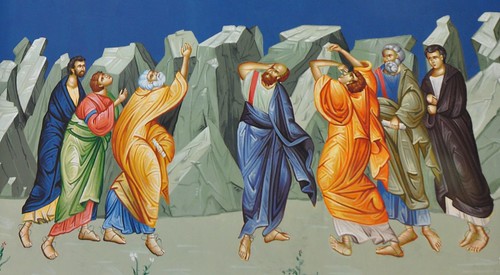
Our subject, presented by the Gospel of St. Matthew these past three weeks, is half-heartedness. Our word for this is apathy, which is an absence of "fellow feeling," a "not caring."
Three Gospel lessons ago, the disciples were of one voice: "Send them away!" The sentiment here is plain enough and all too human: "We've had enough of them!" Here, they voice an us-versus-them proposition: the inner circle of Jesus and His disciples, on one hand, and (as the disciples see it) the exhausting, unwashed masses, on the other. But the Lord turns the tables on His followers, having compassion not on the us part of the proposition but on them. And He responds, "You feed them!" (Mt 14:16).
This marks an invitation to the disciples to exercise their own Divine powers (as I have commented), to meet God in that signature place of the Divine, which is Love, and thereby unleash their Divine powers. Remember, salvation / soter&iactute;a means to unblock, to remove impediments. I say, "Unleash." But the disciples have chosen for themselves at the cost of those they ought to serve (Mt 20:28), indeed, emphasizing their special status as followers of the Master.
It is this moment which Jesus chooses for a kind of theophany, assuming His hallmark role as YHWH feeding the people Israel in the wilderness with a kind of manna. From the disciples' perspective, the overall effect is their shameful failure. Jesus assumes His role as God, the Almighty, the Expansive and Superabundant One. And beside this display of awesome Being stand the pathetic disciples. It is a failure of vocation. It is a failure of faith.
Last week, we beheld Peter preparing to remove his own interior impediments, which have held him back from His Divine role and identity. To use our phrase, Peter is getting ready to step out in the fullness of faith.
Years later he will remember this moment:
|
Finally, all of you be of one mind, having compassion for one another; love as brothers,
be tenderhearted, be courteous; ..... blessing, knowing that you were called to this, that you may inherit a blessing ..... And who is he who will harm you if you become followers of what is good? But even if you should suffer for righteousness' sake, you are blessed. ..... But set apart Christ as Lord in your hearts, and always be ready to give a defense to everyone ..... for the hope [elpís] that is in you, ..... For it is better, if it is the will of God, to suffer for doing good than for doing evil. (1 Peter 3:8-17) |
Peter enjoins us: "Step out in faith! Act on your ..... the Greek word is elpídos, meaning, not quite hope but your expectations of God's will. Risk! For if we fall short in acting on the will of God, this is no different than falling into sin." Indeed, to fall short, Peter suggests, is to dethrone Christ as King in our hearts (line 15). As always, we face a crossroads. We are either with Christ, or we are against Him. As we have considered on many Sundays, with Him there is no middle way.
These are (of course) St. Peter's "overflow of powerful feelings ..... recollected in tranquility" (Lyrical Ballads), to borrow Wordsworth's language. They trace back to an epiphany — a life-and-death moment which unblocked and clarified Peter's vision of his own Divine identity ..... and the moment he shrank back into being a man of lifeless clay.
Do you think I exaggerate? If so, then consult the Lord's opinion:
|
And immediately Jesus stretched out His hand and caught him, and said to him,
"O you of little faith, why did you doubt?" (Mt 14:31) |
For Jesus this is about one thing: the fullness of our faith, which is our salvation.
This week, our Gospel lesson takes us far beyond the Lord's exasperation with Peter. Here He vents His frustrations with us to the full:
|
"O faithless and perverse generation, how long shall I be with you?
How long shall I bear with you? Bring him here to Me. ..... " And Jesus rebuked the demon, and it came out of him ..... Then the disciples came to Jesus privately and said, "Why could we not cast it out?" So Jesus said to them, "Because of your unbelief; for assuredly, I say to you, if you have faith as a mustard seed, you will say to this mountain, 'Move from here to there,' and it will move; and nothing will be impossible for you." (Mt 17:17-20) |
Jesus promises, "Nothing will be impossible for you!" The only possible context for this statement is the fullness of our Divine powers, for nothing on earth might hope to rival them.
Seeing Jesus exorcise this demon (remember, the disciples have sovereignty over demons), they are humiliated, a fact attested by the fact that they asked him "privately." And Jesus acts on this moment of their humiliation: using a Greek word ολιγόπιστις / oligópistis that does not mean unbelief (which the King James translators chose) so much as it means littleness. He says they are little men, dwarfed by the least among creatures of the earth, the lowly mustard seed (about 2mm in diameter).
This is not merely Divine exasperation; it is abject disgust. The scale and scope of it point even to the limits of His Incarnation, for they all know by now, He is the Son of God, Who has condescended to visit them. You see, in this the context in which He cries out,
| "How much longer must I bear with you!" |
And they might have said to each other, "This is the first time He's threatened to walk out on the whole thing."
He confirms this Divine context with His mention of mountains, which are trivialities in the Presence of God.
It is here, more than anywhere else in the Gospels, that Jesus remonstrates at our half-heartedness. In effect, He says,
| "Ye are gods!" (LXX Ps 81), but you behave like half-hearted slaves." |
These tones resonate to something much larger, even to a cosmic and eschatological scale — reaching back to Eden and ahead to the final judgment. For this is the human problem God has faced since the Creation of Humankind: the human problem, a deadness of spirit which has occasioned, now, the Incarnation itself. That is, they have become lost sheep in their deadly apathy, and the God has sent His Son to gather them (Mt 15:24).
Our Lord was born in "David's royal city" — circumstances we rightly celebrate and trumpet to the world as part of His continual kingly progress in our midst even to the furthest corners of the earth. But let us pause to consider the scene in the streets of Bethlehem the night He was born. Look around you. Is there anything royal about this place? We believe there were no shrines or monuments to David in this century or in the preceding six centuries, at least since King Josiah's reforms. In the neighborhood, there are shepherds, known to be shiftless characters, probably petty criminals hiding along the margins of society. Meantime, David's royal Son is accorded the meanest quarters imaginable consigned to sharing dung-stained hay with barnyard animals and placed in a filthy, wooden feeding trough (i.e., manger) for His crib. For all of David's descent from Judah, there in no remembrance of him, nor of any Patriarch, in Bethlehem. For in the year 1, the environs of Judah have been completely remade after the image of Persian culture and religion which was then Hellenized and Romanized. Little of the thought-world of the Patriarchs remained. Indeed, that thought-world had been systematically eradicated beginning with the reforms of Josiah.
The stories given pride of place were those of Moses and especially of the Tabernacle, for these were most amenable to accepting the cultic layer of Babylonian beliefs. You see, this layer of priestly activity might be placed over the Scriptures and might not be noticed by the people, nearly all of whom were illiterate.
Accordingly, Jesus will be reared, not in Bethlehem, not in Judah, but in Nazareth of Galilee, (which will have prophetic significance) but for now it is enough to say that in the historical Northern Kingdom of the first century, the Patriarchs continued to be honored, and the "matter of Moses," continually urged by the temple authorities, was deprecated.
By the time the Protomartyr Stephen would be tried, this was principally the case against him: "We have heard him speak blasphemous words against Moses" (Acts 6:11). And looking ahead to the Book of Revelation, we find that the burning point of the world is defined as a struggle between faithfulness and Babylon.
But how did all this happen? How did the Twelve Tribes of Israel fall under the spell of Babylonian religion. It is true that compulsion played a role. Their neighbors in the regions of Mesopotamia exerted not only powerful cultural influences but also military compulsions. Yet, "the mind is its own place and, in itself can make a heaven of hell, a hell of heaven" (Milton). The people scattered throughout the Levant were free to exercise the sovereignty of their minds and wills. In fact, The Essenes, one Hebrew sect in this sectarian world, did just that, continuing to practice the "virtue of religion" of the Patriarchs while explicitly rejecting the "blood-sacrifice religion" of the temple.
But weren't the Essenes a small, marginal group of fanatics, living in caves near the Dead Sea? No, now they were one sect along side other sects, roughly equal in size to the Pharisees, and scattered all over the Levant. They stored their library near the Dead Sea, prized for its arid conditions for purposes of preserving paper. As far as being a sect in this diverse sectarian world, they were mainstream.
Yet was our God faithful. Healing this epidemic blindness (how often does Jesus encounter a blind person?); revealing Heaven and the angels which the temple authorities rejected (what does He say after He calls His disciples in the first chapter of John: "you shall see Heaven open, and the angels of God ascending and descending upon the Son of Man"); gathering the lost sheep with compassion; our God "stayed us" through this deadly fever in order that we might reclaim our birthright to Heaven: knowing Him and loving Him.
You know the rest of this story. Through the twists and turns of human vicissitudes, God brought about the destruction of the hated temple. Indeed, He sealed off this whole Judah-ite thought-world in 70 A.D. covering it with a field of rubble and impenetrable dust that would render it unintelligible for nearly 2,000 years. You see, He always has the last word.
It is ironic in the extreme, therefore, that this lifeworld, which Jesus and His followers deplored and opposed, which Jesus reviled saying He would destroy it, which was the cause to which He would be martyred, and which Almighty God sought fit to seal off and prohibit — I say, ironic in the extreme that this lifeworld should be posited today as representing Jesus and His teachings.
The deliberate obfuscations and manipulations of the historical data would be many. Jesus of Nazareth would have to be reinvented as a pious Jew. The devout Jewishness of His disciples also be must forced upon us. Jewish practices and customs must be laboriously recovered to explain so-call mindset and sensibilities of Jesus. Meantime, we know that the temple authorities laid down the charge to St. Stephen that His Master would "destroy this place and change the customs which Moses delivered to us" (Acts 6:13-14).
There is it, boldly, explicitly, and directly stated. And the occasion is the longest section in the Book of Acts, which is occupied with the martyrdom of St. Stephen. How in the world are we to ignore this?
But why? Why should we, across epochs of history, bow to this Babylonian cult, which we call Judaism. Why should we make the same mistakes which the ancient Israelites had made in the Northern Kingdom? Why should we fall under the same spell of Babylon which had become the everything and the all to the elite among the Judah-ites and the battle cry of the Maccabees?
The answer in part is inertia. The steady state of any broadly held belief tends to remain as it is. Consider the alternative, which is to set one's prophetic face against many generations of scholars and the bishops who believed them.
But, remember, if God has taught any lesson this past half-century, it is that the beliefs of many people are not a proof of the truth. For example, did you know that there is no such thing as a woman. Gender is a social construct. For God Himself has been overthrown in the public square in the West, at least. And (as a Catholic priest forever) I cling to John Paul the Great's Veritatis splendor, which espouses the principle, "You cannot vote on the truth." And I am reminded of St. John of Kronstadt, who said, "Hell is a democracy. In Heaven you will find a Kingdom" ..... and the Way and the Truth and the Life.
As for those who are not clergy or monastics, the great temptation is convenience. For it turned out that the thought-world of Persian Judah did not entirely disappear. How could it? Under the Maccabees, institutions called synagogues had been constructed from Arabia to Rome for purposes of promulgating the "academy of Moses." And a faction of a faction of Judah-ites, called the Pharisees, were able to escape the general catastrophe of 70 A.D. to the Jewish Diaspora, to places like Alexandria, Elephantine, and to the West. They would set the table for generations of historians, archaeologists, anthropologists, and even liturgiologists. After all, there was so much there there. And in accepting this legacy, countless scholars and churchmen would be set up for centuries. Talk about cottage industries.
Then, of course, there is the matter of our ongoing self-interest. You see, if I were to go out into the public square and hawk religion, this is a very easy religion to sell. For if we accept the vision of Jesus sacrificing Himself after the fashion of the Persian hybrid temple as the sole means of our redemption, we stand to gain all and while giving very little. Indeed, the endpoint of this quid pro quo theology is that we are not able to give anything. Given a theology that teaches our own original wretchedness, we can do nothing for ourselves. Jesus must accomplish all. How convenient.
But today we are presented with a formidable problem: the best evidence now points in the opposite direction. I will not review the variety and scope of that evidence here but will mention five landmarks:
|
Dead Sea Scrolls (1946-47)
Yehezkel Kauffman, The Religion of Israel (1960) Shaye Cohen, The Beginnings of Jewishness (2001) John J. Collins, The Invention of Judaism (2017) Yonatan Adler, The Origins of Judaism (2022) |
For Orthodox people of faith, the holy obligation before us is to read the Gospels in this purified light and to meditate upon them, indeed, upon all Holy Scriptures, I say, in this purified, sacred light. For this is the vocation of Holy Orthodoxy. We seek the original. We seek the pure. We seek the pristine where we can find it. Then we must exercise every means to protect it. I have every confidence that had the Church Fathers lived to see this great breaking through of Divine light, they would have done no different.
But let us not try the Lord's patience, for the meek and mild Jesus of infinite patience and mercy is no less a fiction than the vain imagining that He is a blood-sacrifice offered for our sins. Let us be spared from the Divine judgment which we have already heard from His lips:
| "O faithless and perverse generation, how long shall I be with you? How long shall I bear with you?" (Mt 17:17) |
We must be ever mindful: God's very element is love. He is a Society of Love within Himself. He created us, fashioning our every detail, in an act of unimaginable love. And the place where we meet Him, inevitably, must be love.
You see, the great task of our lives is to requite that love with which He has loved us. Are we not taught this within the prism of our lives in our relationship with our parents, who sacrificed everything for us, who set aside their own lives in order that we my go forward, who wept for us and denied themselves for us ..... how can we begin to requite that love?! And how much greater is the love of our God, Who numbers the hairs on our heads and Who ponders our every next word and deed. He has given us the experience of transcendent love to teach us love's ways.
Have you ever given the fullest measure of your sacred love?
Have you ever fully opened your heart, stretching every sinew and spiritual nerve?
To have done so is to have known greatness.
And if this greatness of heart and soul should be met with
indifference,
even half-heartedness,
then
you have learned a holy wisdom.
You have taken your first step in compassion toward our Father Who is in Heaven.
Standing on this sacred ground,
remove your shoes and begin this holy journey into the Fire of Love,
which is our God.
In the Name of the Father and of the Son and of the Holy Ghost. Amen.