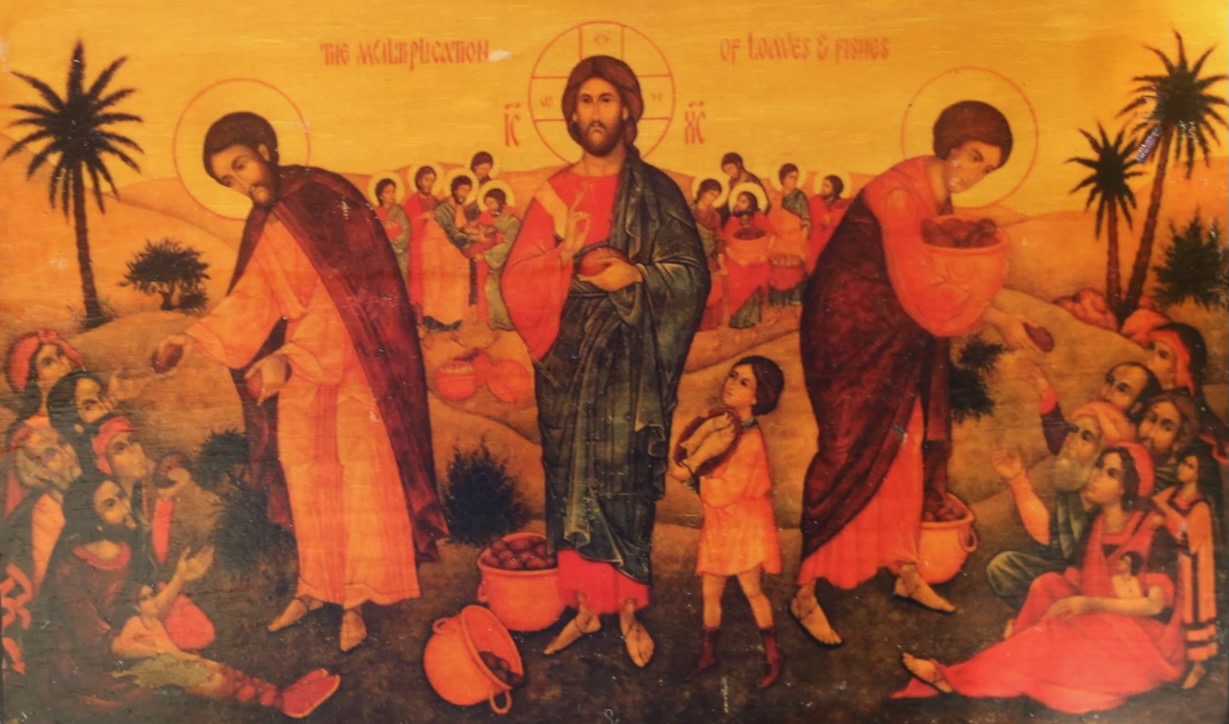
John 20:11-18 (Matins)
1 Corinthians 1:10-18
Matthew 14:14-22
"Come!"
But Jesus said to them, "They do not need to go away. You give them something to eat."
(Mt 14:16)
In the Name of the Father and of the Son and of the Holy Ghost. Amen.
The event
we recognize immediately:
Jesus frankly and explicitly revealing His Identity as Providence,
repeating that hallmark act of God
—
the feeding of the multitude in the wilderness with manna.
Incidentally,
the Gospel tells us there were "five thousand men,
besides women and children."
If these were married men,
then the number expands to 10,000.
If their children accompanied them,
then the numbers swells to perhaps 20,000 or 30,000 or more.
This is not a crowd but truly a multitude.
As was the case in the Old Testament,
we behold
God as He creates ex nihilo.
In this we
behold
His victory
over chaos,
both material and moral chaos
as He makes a desert productive and reproves the Disciples for their apathy
(their response to this general need was, "Send them away!")
But the overarching point is that Jesus continues to reveal Who He Is.
But let us set the context,
for the scenes preceding and following
in the Gospel According to St. Matthew
will bring all into focus.
The trend of the narrative is unbelief.
The people of Nazareth cannot square Jesus' humble and familiar
beginnings with the plain fact of His Divinity:
When He had come to His own country, He taught them in their synagogue, so that they were astonished
|
The conflict,
of course,
is theirs:
"They were offended at Him?"
And what could this offense be other than,
"Who does He think He is?!"
That is,
the sins of envy and pridefulness are in conflict with
due piety and fear of God.
To quote Jesus only two chapters earlier in Matthew's Gospel,
For if the mighty works which were done in you had been done in Tyre and Sidon,
they would have repented long ago in sackcloth and ashes.
(Mt 11:21)
|
Herod the Tetrarch also wrestles with the same problem:
he cannot square his due piety before God
(in this instance, God's prophet),
with the chaos of his human passions.
As is always the case when we encounter the Divine,
our passions are shown in sharpest focus
and
Herod's interior life is displayed in all of its pandemonium:
And the king was sorry; nevertheless, because of the oaths and because of those who sat
with him, he commanded it to be given to her. So he sent and had John beheaded in prison.
And his head was brought on a platter and given to the girl, and she brought it to her mother.
(Mt 14:9-11)
|
That is, the king's striving to honor the unwritten laws of man
are
in tension with the plainly written obligation to honor God.
Learning of this depravity,
Jesus departs to a desert-place,
and
the multitudes, hearing it, depart from the cities and follow Him there.
From the cities.
Isn't this always God's call?
We are to depart from Ur of the Chaldees.
We are to leave Babylon.
Otherwise,
we cannot begin
the long trek towards God and Paradise.
The Forerunner had exhorted them,
"Turn around!
You're going the wrong way!"
And
bid them wash the filth of the city and city ways off of them.
Disordered humanity.
God, the Victor over chaos.
The crisis of a disjointed world facing the perfect lineaments of Heaven.
These themes echo throughout the Gospel of St. Matthew
and
tell a coherent story
completing our meditation this morning.
But, this morning, I would like to go a step
further
and
single out this Divine command:
|
You give them something to eat.
(Mt 14:16)
|
This is not mere irony.
This is an invitation to Jesus' human Disciples to act on their own Divine powers.
"You feed the lost tribes of Israel with manna!"
To underline this fact,
Matthew immediately follows the Feeding of the Five Thousand with another
invitation to Divine life
—
Jesus' encouragements to Peter to walk on the sea
(the symbol par excellence of God's mastery over chaos):
And Peter answered Him and said, "Lord, ..... command me to come to You on the water."
So He said, "Come." And when Peter had come down out of the boat, he walked on the water to go to Jesus.
But when he saw that the wind was boisterous, he was afraid; and beginning to sink he cried out, saying,
"Lord, save me!"
And immediately Jesus stretched out His hand and caught him, and said to him,
"O you of little faith, why did you doubt?" ....
Then those who were in the boat came and worshiped Him, saying, "Truly You are the Son of God."
(Mt 14:28-33)
|
The point here is not Peter's pridefulness.
For Peter does walk on the sea
and
at the Lord's command: "Come!"
Yes, Jesus will reprove him, but not for any imagined pretensions.
Far from it.
He reproves him for not being more confident.
After all,
as these men and women follow the Master is not theosis the whole point?
Does not our salvation
(sotería: the cleared path ahead)
lie in our becoming what we were created to be:
the children of God?
And by that fact, do we not become gods ourselves?
Certainly this is the expectation of our Father in Heaven:
|
I said: Ye are gods, and all of you the sons of the Most High.
(LXX, Ps 81:6)
|
☦
We in the West repeatedly stumble on this subject.
The Western theologians of old protest,
"Pridefulness!"
the first of the Seven Deadly Sins.
And they bring the charge into further focus with
the examples of
Lucifer's sin in Heaven
and
Eve's sin in Eden.
The charge is redoubled and amplified:
"You made yourself the equal of God!"
They counsel passivity.
But the East replies,
theosis either is the purpose of our lives,
or it is not.
And they counsel a vigorous pursuit of God,
even a journey to the Gate of Heaven.
"There are two ways: life and death,"
begins our first treatise on Christian life,
The Lord's Teaching Through the Twelve Apostles to the Nations.
And those Apostles knew there were two religions:
the cult of Judah
and
the Kingdom of Heaven.
The struggle between them was the principal work of Jesus' ministry.
Appeasing God with bloody sacrifices,
advocated by Judah-ism,
or
The Way,
taught by God in the Person of Jesus.
According to the former,
we can do nothing to help ourselves,
only to offer blood-sacrifice
in hopes that our god is appeased.
One thousand years after Jesus' death,
an Italian Benedictine monk named Anselmo refined this idea
into a theology of atonement (at-one-ment).
The idea here is that
we attain unity with God through the sacrificial offering of His Son.
But even Abraham was taught in the most dramatic terms
that such an idea, the sacrifice of one's son,
is grotesque in the extreme.
This theology of atonement,
nonetheless,
was continually refined to
include the premise that on account of Original Sin
and
our consequent wretchedness,
we can do nothing to help ourselves.
Only God can do it for us.
The origin for this idea is Augustine of Hippo,
who decisively shaped the beliefs of the Western Church.
It is important to realize that Augustine did not know Greek,
distancing himself from the Greek Fathers.
Perhaps no figure has done more damage,
and is execrated on that account,
than Augustine.
Closer to our own time,
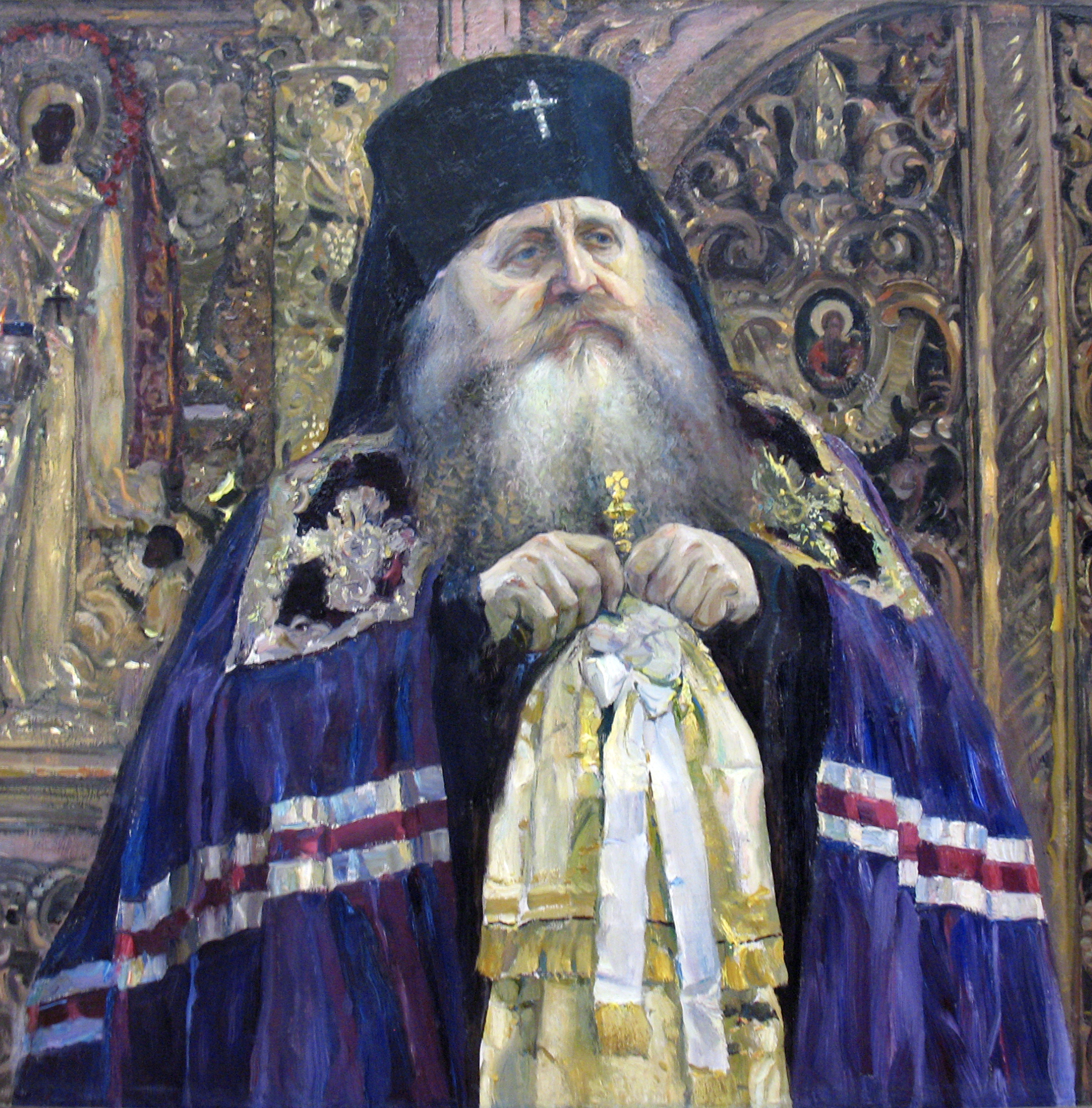
the inaugural First Hierarch of the Russian Orthodox Church Outside Russia,
Metropolitan Antony Khrapovitsky,
was a foremost teacher in Russia's theological academies,
tireless in his efforts to rid them of Latin influences.
The story is too long to tell
but perhaps we can build on what is well known.
Czar Peter I (1672-1725)
attempted to secularize Russia
importing so-called Enlightenment ideas and values.
He demanded men, including priests, shave their beards through a beard tax,
to soften the image of a Russia "stuck in the Middle Ages."
He removed the Patriarch of the Russian Orthodox Church
and
packed the Synod with his men,
making the Church effectively a department of his government.
He both chose (through the power of veto) and invested new bishops.
He invited theology teachers from the West who would implement Scholasticism.
The knew language of the seminaries would be Latin.
And naturally Augustine would have pride of place.
The long dominance and lasting influence of Western Catholic theology
upon Russian Orthodoxy have become known as the
Three Hundred Year Latin Captivity.
Extricating Russia
and
ultimately the world
from the death grip of this false religion
has
been the work of the disciples of Jesus from the beginning.
He sent them to the ends of the earth
to preach this message.
But,
according to the proverb,
every heresy returns again and again like a bad penny.
And perhaps no heresy shimmers and tantalizes like this one.
Small wonder, so many so-called Christians point to the Cross
as if it were a blood-sacrifice for their sakes,
or, worse,
a great magic wand.
For in that case, nothing shall be required of us.
We need give nothing but only lapse into passivity and receive.
Repeating Augustine and, later, Calvin and Luther,
many say,
"I am wretched!
I am helpless!
But Jesus is able!"
And
they imagine this to be humility.
But this is no more humble, much less noble,
than a grown man who refuses all his obigations.
Far worse than this:
we must own the inevitable implication of refusing
self-sacrifice,
pointing to the Cross,
and
saying in effect, "His hide, not mine!"
Must we not (at that point)
number ourselves among those who
shout, "Crucify Him!"
☦
But God has come making us aware of the greatest fact of our lives:
the Kingdom of Heaven surrounds us,
towering above all else with its royal splendor.
And we have been called as royals! This is a high calling requiring self-mastery and due comportment.
Do you struggle with chaos?
Do your passions have the upper hand?
You cannot be an heir to the Kingdom if you are not even master of this chaos.
We are made for Heaven.
But we have abandoned our noble obligations if we tolerate chaos in the sacred precincts of our inner lives.
We are born and raised up to face formidable foes.
Shall we now be stymied by the ignoble and the trivial: darting thoughts or random impulses?
When we encounter God but choose the ways of man, we feed this chaos,
and we unleash our passions as never before, ..... as Herod did.
The result is depravity. And our end is assured:
chained to the house of death and riddled with demons by the legion like the shattered forms in Gad.
He sent His Forerunner,
the man of Eden,
to change our course and be purified.
He began His royal progress through the winding streets and byways of humanity
with the same proclamation:
"Metanoeite!"
Then He commanded us, "Take up your crosses and follow Me."
He said, "No greater love hath anyone than to lay down one's life for a friend."
He said, "The one who seeks his own life will lose it!"
If we do not follow Him in this cruciform-shaped life, then we have rejected Divine life.
If we do not lay down our lives for the benefit of others, if we do not enter the journey of becoming Him,
we have squandered a priceless possession, even our very lives.
And, then, later, when we hear Him say to us,
"Lord, Lord, you call Me Lord! I say that I never knew you! Depart from Me, ye evil-doers!"
are we not silenced by the truth of His words.
Here is the famous crossroads.
Here are "the two ways."
Turn to the right.
For life in this world is brief and treacherous, and the demons always laugh at our stupidity
in preferring the worthless and the ignoble.
Choose life.
Choose nobility.
Choose God.
In the Name of the Father and of the Son and of the Holy Ghost. Amen.