Much later, in the longest section of the Book of Acts, St. Stephen the Protomartyr will be stoned for challenging the Mosaic teachings as being authoritative. The charge against him is this:
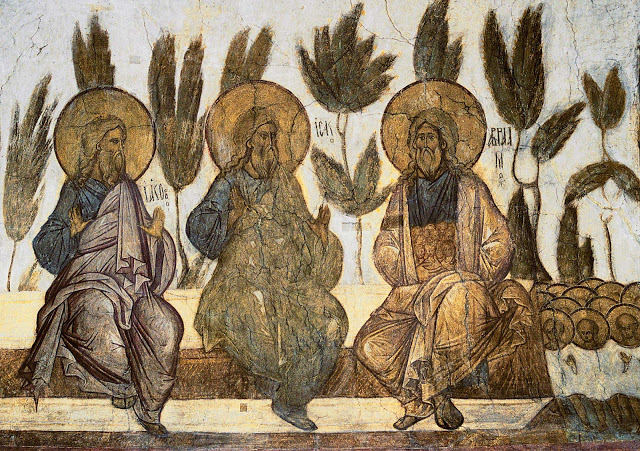
In another setting, "The officers answered [the chief priests and Pharisees], "No man ever spoke like this Man!" (Jn 7:46). For there was never a man like this Man. He is out-of-step with the world. His eyes are Elsewhere. The world is out-of-joint. It cannot be set right. So He must set it on another foundation: its first foundation, set with the cornerstone of Abraham and then built-upon with Isaac and Jacob and, importantly, with Jacob's children, the Tribes of Israel. This is a key to understanding the Incarnation itself.
It will not do to ignore Jesus' teachings. It will not do to ignore His purposes. And it will not do to ignore the historical details of His Person. It is the height of self-interest and ego to rush straight to what we think we can get out of Him. For to say that we want His Blood to wash away our sins, to say that we want His Body so that we may offer a "whole burnt offering" (i.e., a "holocaust") to clear our perceived debts with the Father, is not only selfish in the furthest extreme, but it is also predatory and places us among that number who shouted, "Crucify Him!, Crucify Him!" I mean, how else can we clear our debt. And if we persist, we will eventually come to the crushing irony: His death did not, and will not, save us. It is His Life that saves us. The word salvation, the Greek sotería, means "to clear the path ahead." And what is that path?
He would say,
|
"I go to prepare a place for you. And if I go and prepare a place for you,
I will come again and receive you to Myself; that where I AM, there you may be also. And where I go you know, and the way you know." Thomas said to Him, "Lord, we do not know where You are going, and how can we know the way?" Jesus said to him, "I AM the Way, the Truth, and the Life. No one comes to the Father except through Me." (Jn 14:3-6) |
He is the Life. He offers Elevated Life through adoption by His Father and then Unity with Them as they are One.
Does this sound like a plan for a grotesque ritual of death? It is a fact that the Church of the first centuries did not accept the Cross as a symbol for their faith. That would not occur until the sixth century. The Apostles called their great movement, which sprang up by the thousands and tens of thousands, the Way. We might say, "the Path ahead which has been opened with the knowledge of God and God's purposes." They would have thought of this as "the Way to Life."
Where in the Gospels do you read anything about His Blood entering into a calculus for our personal debts? It would be St. Paul who worked all this out. But, of course, Saul's whole formation was as a practitioner of Judah-ism — the Persian hybrid religion of Judah, established with the return following the Babylonian Captivity. We should remember that Jesus did not choose Saul of Tarsus as one of His disciples..
|
Then he said: "I am indeed a Jew, born in Tarsus of Cilicia, but brought up
in this city at the feet of Gamaliel, taught according to the strictness of our fathers' law, and was zealous toward God as you all are today. I persecuted this Way to the death, binding and delivering into prisons both men and women, as also the high priest bears me witness, and all the council of the elders." (Acts 22:4-5) |
The Twelve Disciples called by the Master were nearly all men from the historical Northern Kingdom — men formed far from the centers of Judah-ism, men like Him who understood that the traditions of God are the traditions of the Patriarchs, and not "traditions" having to do with Moses. Significantly, the solitary disciple from Judah, whom Jesus later will identify to God-the-Father as the "the son of perdition" (Jn 17:12) (that is "of the hopelessly lost in a false religion") is named for this hopelessly lost tribe: Judah (Judas is a variant spelling of Judah).
The Moses material was intensively promulgated by Judah-ite authorities. These traditions were built up around the time of the Captivity — both before, when Judah was a client state led by a weak boy-king, and after the Return from Babylon. Remember, the Second Temple was built by Persians, overseen by a Persian governor (Nehemiah), who directed that the Scriptures be rewritten by the Persian religious figure, Ezra. But the influence of Judah-ism never reached very far beyond Jerusalem until the century preceding Jesus birth.
Much later,
in the longest section of the Book of Acts,
St. Stephen the Protomartyr will be stoned for challenging the Mosaic teachings as being authoritative.
The charge against him is this:
|
for we have heard him say that this Jesus of Nazareth
will destroy this place [the Persian built Temple] and change the customs which Moses delivered to us. (Acts 6:14) |
Stephen then commences to describe the traditions of God as proceeding from Abraham. Here, we see in high relief the false foundation, set in stone in Jerusalem by Persians, and the true foundation, set in the wilderness upon the person of Abraham.
With this morning's lesson, we study one of the most significant passages in the Gospels, explicating to an outsider the Ways of God, beginning and ending on earth with the traditions of Abraham (Mt 8:5-13):
|
|
The key to the Centurion's admittance into the Kingdom is manifestly His countenancing God to be God. This is, after all, is great question to all of us: "Who do you say that I AM?" (Mt 16:15). This is precisely what did not happen with Jesus' visitation to the Tribe of Gad. This is what did not happen in Judah and its environs. This is what did happen at moments and in places along the roads and villages of His roaming royal progress to His people. And this is what would happen soon after His death.
The purpose of the Incarnation is to shake people loose from this invented hybrid Persian-Hebrew religion. Unless they are liberated from this cult, they cannot hope to be saved. What is the principle sin of the world? It is the rejection of God.
We love to quote St. John's Gospel,
|
For God so loved the world, that he gave his Only-begotten Son, that
whosoever believeth in Him should not perish, but have everlasting life. (Jn 3:16) |
The key, of course, is that with recognizing that He is God, we must take our places in being obedient sons and daughters of God. And that is a long and exacting path.
In turns out that all are invited. This is what the Master means when He tells the Centurion, "from east and from west," for that signified the whole world in the first century. Did not the certain King command that everyone be brought into His hall to celebrate the marriage of Heaven and earth? He says, "My hall still is not filled. Go into highways and byways, beat every bush, that you may bring everyone into my hall." Are we not all made in the King's Image and Likeness? The purpose of the Incarnation is gather all for whom the Father has sent and whom God continues to call?
Yes, Jesus tells the Centurion that many will be dispossessed. He has in mind that Judah-ite tradition to whom He offered His Love. But that Divine Love was not to be requited, at least not by the leaders of the Persian-built Temple, which He vowed to destroy.
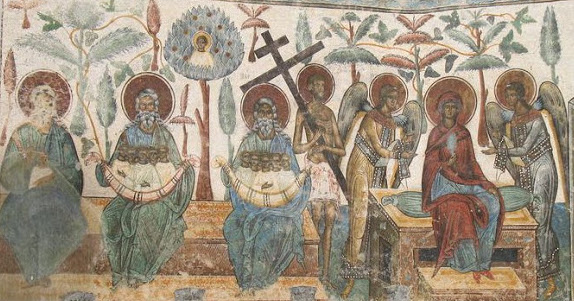
The Church that Jesus founded, which we call Holy Orthodoxy, does not teach a doctrine of atonement (i.e., at-one-ment). We do not offer sacrifices to appease God. We recognize that He is God. We set our sights on taking our own place in the Bosom of Abraham. And we follow Father Abraham in carrying on a conversation with God. The Mosaic model is sacrifice. But what is the model proposed by the example Abraham? St. Paul advanced to the point where he could see it. The model represented by Abraham is (1) recognition that God is God and (2) faithfulness, unwavering faithfulness. God will tell us all manner of things that we must do. Obedience to these things is called theosis. We follow the Lord. We imitate the Lord. We become pleasing to the Lord. And at length we become .... not very different from our Elder Brother, Jesus.
This was His intention in Eden.
It was His intention for Abraham.
And it is His changeless intention for us,
for everyone,
for a Centurion,
for the Jews,
and
for a people yet to be born (Ps 21/22:31).
In the Name of the Father and of the Son and of the Holy Ghost. Amen.