Mark 16:9-20 (Matins)
Romans 5:1-10
Matthew 6:22-33
The Lamp of the Body
"Do not worry about your life, what you will eat or what you will drink;
nor about your body, what you will put on. Is not life more than food
and the body more than clothing?"
(Mt 6:25)
In the Name of the Father and of the Son and of the Holy Ghost. Amen.
This morning
the Master has raised a great question:
What is our life?
And immediately He draws a great distinction:
between
what man has made and what God has made,
between the world and the Kingdom.
He does this
by singling out the particulars of food and wardobe,
which, while they sustain life, also define class and status.
Now, isn't this main point about food and raiment in the Gospels.
It is not a neutral subject.
He asks,
Are we not more than the food that we eat?
Do you see the hierarchy?
Are we not greater than the clothes we seek out and display in public?
Food and clothing are primary markers of social status ..... then and now,
in the twenty-first century.
Who eats the finest cuts of veal?
Who has fresh produce delivered to their homes?
Alternatively,
who habitually eats soup or pot luck stew?
Who buys day-old bread .....
or hardly eats at all?
Our clothing marks us out as well.
It turns out that we are the "wrong cut" of man,
should we appear for a CEO interview wearing anything less than an
Armani suit with handmade Italian shoes.
You might think that I am importing contemporary values
back into Classical Antiquity
—
what we call anachronism.
But that would not be so.
During Jesus' lifetime,
people were obsessed with food and clothing as markers of social status.
Recall Jesus' tale of
".... a certain rich man who was clothed in purple and fine linen and fared
sumptuously every day."
(Lu 16:19)
|
This man dined in full view of passing onlookers.
And he wore purple.
In the ancient world only king's wore purple.
Alexander the Great's toga was recently found dyed all in purple.
Then it must belong to the emperor!
That is,
St. Luke has chosen
a most ostentatious display featuring this "certain rich man."
The zeal for high-status clothing
reached the point
that restrictions had to be enforced.
Roman Senators,
for example,
were permitted a purple stripe on their togas.
In general,
the process for obtaining
this dye was prohibitively expensive
and
time-consuming and labor-intensive.
And only the wealthiest (or most powerful) men could indulge this passion to the full.
In general,
only the rich could afford clothing spun from
the best materials and of a fine weave.
By contrast,
Jesus says of John the Baptist
(who stood far above social distinctions)
"But what did you go out to see? A man clothed in soft garments?
Indeed, those who wear soft clothing are in kings' houses."
(Mt 11:8)
|
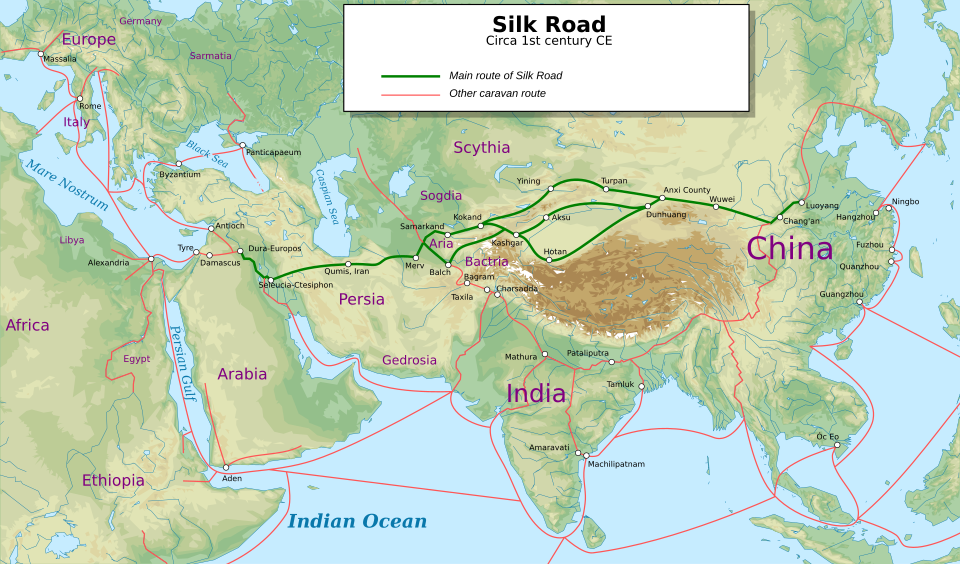
And the softest of all garments,
indicating highest of statuses,
were made from silk.
The arrival of silk into the Mediterranean basin
would be a world-changing event,
sending the affluent world into a frenzy
for the next fifteen centuries
—
plowing paths through the sea
and
forging a network of trade routes over land
—
all to obtain
that precious, impossibly soft, and transcendently beautiful material,
which came alone from the mythical Far East.
Indeed,
silk
would mark the beginnings of world trade.
The century of Jesus birth coincided with the first
instances of silk arriving to Arabia and thence to the Levant.
Never-before-sampled spices
also arrived from the exotic East.
The fragrance of them alone was enough to transport one into another dimension.
Now, here was a world fit for kings,
and,
to be sure, it would be kings alone who could afford such rare delights.
And the exemplar of the king who brought all delights obtainable to himself from far lands,
in the imagination of the first-century Levant,
was Solomon
"in all his glory" (Mt 6:29), Jesus says.
All this sets the scene for understanding our Gospel lesson
at the literal, or historical, level.
The tropological, or moral, level begins to unfold as the Master
takes up the theme
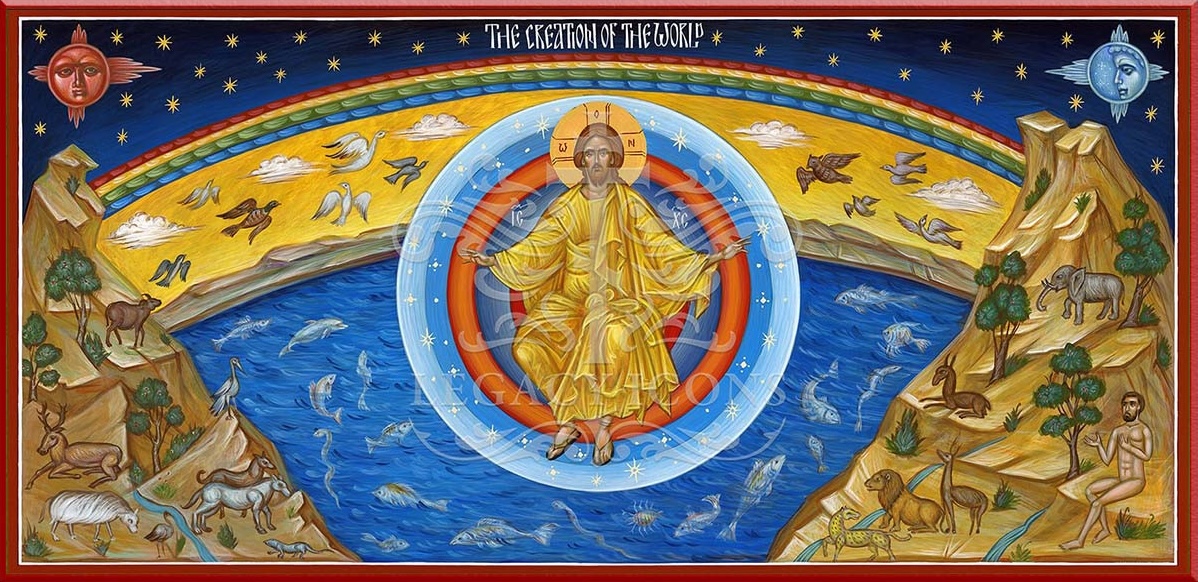
of creation:
what man "weaves and spins" (Mt 6:28) versus what God has made.
☦
"Do not worry about your life, what you will eat or what you will drink;
nor about your body, what you will put on."
(Mt 6:25)
|
These sentences are spoken in the imperative mood,
grammatically speaking,
and,
therefore,
Divine commands.
He brings us to attention,
for who dare ignore or would slight the commands of God?
He then
addresses Himself to the puny things man has managed to manufacture
versus
what God has created.
That is, He traces His Finger
over the matchless canvas of His Creation:
"the birds of the air .... the lilies of field .... the grass .... the grain gathered into barns."
Yet, this is one of those rare moments when we are able to turn away from Sacred Scripture
and
see a truer version of what He describes all around us today.
Indeed,
we see an instance that is livelier and truer than any printed words could ever be.
For what God has Created constantly renews itself
in brilliant, pristine hues and fresh, inimitable fragrances
—
the morning of the earth hinting of the scent in Eden.
What is like it?
What comes near to this?
Now this is a fabric which is always beautiful and new.
What is the subject every artist attempts to portray?
The Greeks used the word mimesis to convey this:
the artist holds the mirror up to nature.
But try as we might,
no artist has come close to rivaling the Master.
For who could create this Art of endless variety that has that mysterious,
more-than-lofty quality:
stirring, sentient, life?
Do you think silk is soft?
Then compare it to the rose petal or the daisy or the lily.
Who spun and weaved this fabric?
They did not travel thousands of miles from the Far East.
They are not be presented before royalty alone.
No.
They are growing all around you and in profusion for everyone.
Why are flowers so impossibly soft?
Why do they appear in myriad colors which no dye could match?
And Who added to these colors beguiling fragrances,
with which no cloth might be endowed?
Why was all this created?
Why did God create this things as He did?
If you consult the authoritative opinions of biologists or horticulturists,
they can give you no more than a reductively,
materialist answer.
For they have trained themselves to limit their investigation to empirical and scientific study ....
that is,
of matter.
They will never say, ".... because evidently, God loves beauty, for they are without rival in their beauty."
They will never say,
".... because God fashioned people in His Likeness and Image whom He surrounds with
uplifting bird-song, transporting fragrances, and dazzling colors."
He has made us to be moved by beauty,
and
He in His Own Beauty
has surrounded us with beauty.
Here on our Polynesian island,
Saffron Finches are seen in short grass in morning light.
They take flight before us, and the fresh air is lighted with flashes of yellow, green, and pink.
In the distance
the Chinese Melodious Laughing Thrush (Hwamei) sings lustily with its brilliant display of melody
and
range of sweet notes.
You never know what he is going to "say" next.
And the air is fragrant with a multitude of blossoms from the trees and fields.
Now, this is something that it took time to get used to,
for Hawaii is always in bloom with something.
God created beauty to let us know that the Kingdom of Heaven is beautiful.
And when He had finished His canvas, the Earth, He set His signature upon
the wide expanse of the Pacific Ocean,
with His fingerprints,
the Hawaiian Islands
with His thumbprint set down upon Big Island.
For everything is here.
And it is God alone Who is able to do this.
But if you follow the world in an obsession for silk,
if you are obsessed with the scent and taste of rare spices,
then the lamp of your eyes begin to dim,
and
darkness begins to gather inside you.
And how great, therefore, is this darkness!
Alternatively,
|
"If therefore your eye is good, your whole body will be full of light!"
(Mt 6:22)
|
The eyes are the lamp of the body ..... and the soul.
And goodness is the only unfailing light.
Therefore,
the Lord commands,
fix your eyes upon the things of God.
For they alone are beautiful,
and
like Lazarus the beggar,
who set outside the gates of the rich man watching him eat,
yours will be
the place of beauty itself:
the Bosom of Abraham,
whose other name is Paradise.
In the Name of the Father and of the Son and of the Holy Ghost. Amen.